
Quick answer: Styku accuracy depends on the output and body-composition model being assessed. Its optical scan captures body shape, while software estimates composition from that information. Published research supports useful precision under controlled conditions, but a circumference error cannot be applied to body-fat percentage. Keep the model consistent when comparing scans.
Your waist estimate looks stable, but the body-fat number changes after a software update. Those outputs may come from the same scan while using different calculations. Before deciding that either result is wrong, identify what changed in the measurement and reporting process.
Research basis: This is a literature and documentation review checked September 6, 2026. We have not taken a Styku scan. Michael Rode, founder of GainFrame, wrote this guide; our app also uses images for progress tracking, with a different workflow and its own limitations.
If you are buying a service for a gym or coaching business, use the body-scanning platform comparison to compare Styku, current SNAP by Fit3D and a photo-check-in coaching workflow.
What does a Styku scan capture?
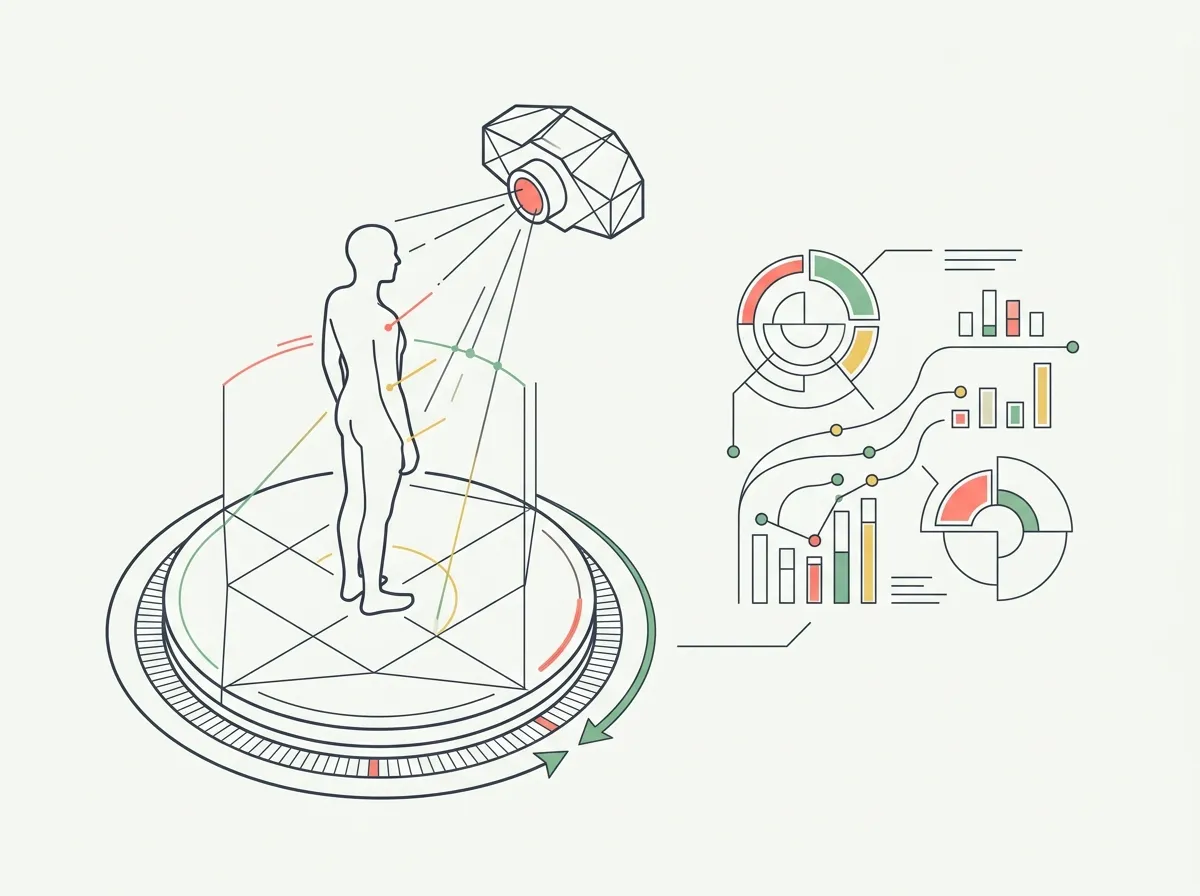
Styku uses optical scanning to create a body-shape model. Its documentation distinguishes scan-derived dimensions from body-composition estimates produced by a prediction model. That distinction matters when a provider advertises a single accuracy percentage for the whole report. Styku's measurement overview
A circumference is a length around a defined location. Body-fat percentage is a composition estimate. Accuracy established for one endpoint cannot automatically be transferred to the other.
| Report element | Evidence you should ask for |
|---|---|
| Waist or hip circumference | Agreement with a defined manual measurement protocol |
| Repeat circumference | Variation across repeated scans under stated conditions |
| Body-fat estimate | Agreement with a reference assessment for the exact model |
| Regional composition | Validation for that particular regional output |
| Change over time | Consistent procedure and model, with uncertainty considered |
What did the published Styku validation find?
A 2022 paper studied 188 adults using duplicate Styku S100 scans and DXA. The methods specify software version 4.1 and the Advanced composition model. Researchers reported body-fat test-retest precision of 0.60 percentage points and waist and hip precision below 0.60 centimeters. Bennett and colleagues, Clinical Nutrition
Those precision figures describe repeat scans in that study. They are not maximum individual errors against DXA. The researchers separately analyzed agreement, including offsets and limits of agreement, and concluded that offsets matter when interpreting the estimates.
The result is useful evidence for the tested setup. It does not establish the same performance for every subsequent release, scanning environment, or person. That boundary is why the software version and model deserve a place beside the headline finding.
Why do the Basic and Advanced models matter?
Styku's documentation describes separate Basic and Advanced composition models, with different calibration references and available outputs. It explicitly advises using the same model when following a client over time. Styku model documentation
If a provider changes the model, an apparent jump in body-fat percentage may reflect that change rather than a sudden physical transformation. Ask which model produced each report before subtracting the numbers. Do not select whichever model gives the result you prefer and combine it with the old history.
The same caution applies when the labels or category thresholds change. Keep the original report so you can tell whether the underlying value changed or only its interpretation did.
How should you investigate a surprising result?
Start with a comparison log. This worksheet is our suggested process; it contains no original scan data.
| Question for the provider | Why the answer helps |
|---|---|
| Which device and software version were used? | Identifies a potential change in the system |
| Which composition model is active? | Prevents comparing unlike estimates |
| Were clothing, positioning, and scan quality comparable? | Checks the conditions behind the shape capture |
| Does the circumference use the same landmark? | Makes a tape comparison interpretable |
| Is the difference larger than expected repeat variation? | Puts a small change in context |
| Can I retain both original reports? | Preserves the evidence behind the trend |
If you compare a tape reading with the scanner, first agree on the measurement location. Two careful measurements at different waist landmarks can disagree without either person making a simple reading error.
The existing body-measurement guide covers a consistent tape routine. The body-composition methods guide covers the broader choice of measurement technology.
Is Styku useful for tracking progress?
It can be useful when the scan routine is repeatable and the outputs answer your question. Shape and circumference records may help you observe changes that a single body-weight value does not describe. The evidence still needs to match the specific interpretation you make.
For example, a smaller measured waist is a different claim from a precise amount of muscle gained. A rendered shape cannot directly tell you which tissue accounts for every change. Keep training and other relevant observations with the report rather than treating the body-fat field as a complete explanation.
If you also want a visible record, use consistent photos at your own check-ins. Photographs preserve appearance; they do not validate the Styku composition model.
Which sources support this guide?
We used the original Bennett validation paper, Styku's measurement explanation, and its Basic-versus-Advanced documentation. The company's precision terminology guide also separates these concepts. The worksheet identifies what a useful comparison should record.
What else should you know?
How accurate is a Styku body scan?
Accuracy depends on the output, model, and procedure being evaluated. Published research supports the tested system under specified conditions, but a single marketing percentage cannot summarize every field in a report. Ask whether the evidence concerns circumference, repeated scans, or agreement of a composition estimate with a reference method.
Does circumference accuracy establish body-fat accuracy?
No. Circumference is a length around a defined location, while body-fat percentage is a composition estimate. A small circumference error cannot be applied as a body-fat error bound. Each output needs its own validation, and repeated consistency is a separate property from agreement with a reference assessment.
Why can Styku body-fat results change after an update?
Check whether the update changed the composition model, report labels, or other relevant settings. Styku documents separate Basic and Advanced models and recommends keeping the model consistent for longitudinal comparison. Ask your provider to identify the settings on both reports before interpreting the difference as a physical change.
Can you compare Styku with a tape measure?
Yes, if you compare the same circumference landmark using a documented technique. A tape and a scanner may define the waist differently, so agreement cannot be judged from the field name alone. Record the location, procedure, and dates, and keep repeat measurements rather than selecting whichever pair agrees best.
Can a Styku scan prove that you gained muscle?
A modeled composition change cannot prove muscle gain by itself. Confirm the output definition and whether scans used comparable settings, then interpret the report alongside training and other relevant observations. This guide reviews published evidence and does not contain personal Styku results establishing muscle gain or loss.
Keep a visual record of your progress
Use GainFrame on iPhone to organize progress photos and compare check-ins. Photo estimates have limits; a consistent visual history gives you another observation alongside your logs.
Get the app for iPhone