
Quick answer: Withings Body Smart is the default choice for weight and body-composition tracking at a lower price. Body Comp adds vascular age and, in the US, an Electrodermal Activity Score. Both share the core app workflow without requiring Withings+. Choose Comp for those extra features; this comparison does not establish superior body-fat accuracy.
Withings Body Smart vs Body Comp is a choice between two levels of health tracking inside the same app. Both already cover the weight and body-composition routine most lifters want. The extra spend needs to make sense for the additional measurements you will actually use.
This comparison uses US manufacturer listings and support documentation checked September 29, 2026. It covers Body Smart and Body Comp, without borrowing handle-based features from BodyFit or Body Scan. We have not run a controlled accuracy test between these two models.
Which should you buy, Withings Body Smart or Body Comp?
Body Smart is our default pick for a lifter tracking weight and composition over time. It provides the core recordkeeping workflow at a lower price. Body Comp becomes more compelling if you specifically want its vascular-age and electrodermal-activity features and understand how you will interpret them.
Both live within Withings' connected ecosystem. Upgrading does not buy a different Apple Health integration or a reason to abandon consistent measurement conditions. Start with the data you need, then choose the hardware.
Which features do both scales share?
Both offer weight tracking, estimated body composition, standing heart rate, Wi-Fi/Bluetooth synchronization, a color display and automatic recognition for multiple users. These overlap enough that a basic “does it measure body fat?” checklist will not settle the purchase.
The current Withings scale comparison helps distinguish these models from the company's handle-equipped products. Body Smart and Body Comp should not be credited with a Body Scan ECG or a handle-based segmental report simply because they appear on the same comparison page.
For broader alternatives, see our smart-scale roundup and the body-scanning and measurement guide.
What does Body Comp add over Body Smart?
Withings' Body Comp FAQ identifies vascular age and a regional nerve/skin-related measure as distinguishing features. In the US, the relevant name is Electrodermal Activity Score. Documentation for other markets may use Nerve Health Score; availability and interpretation are region-specific.
Those extras are the main reason to choose Body Comp. They give you additional health-related information in the same routine as your weigh-in. Decide whether you want to review those outputs and discuss concerns with a clinician before paying for them.
A favorable score should not reassure you about symptoms, and an unfavorable one should not become a self-diagnosis. Read the intended use and limitations of the particular feature in your region.
How do Body Smart and Body Comp compare side by side?
| Feature | Body Smart | Body Comp |
|---|---|---|
| US store price, September 29 | $129.95 | $229.95 |
| Weight trend | Included | Included |
| Body-composition estimates | Included | Included |
| Standing heart rate | Included | Included |
| Vascular age | Not included | Included |
| Electrodermal Activity Score in US | Not included | Included |
| Wi-Fi and Bluetooth | Included | Included |
| Apple Health through the iPhone app | Supported | Supported |
| Hand-electrode segmental analysis | Not included | Not included |
| ECG recording on the scale | Not included | Not included |
| Withings+ needed for core measurements | No | No |
| Best fit | Weight and composition tracking at lower cost | People who value the additional health metrics |
Prices come from the linked US Body Smart and Body Comp listings. Promotions, bundles and regional availability can change. Check the final product and country selection before ordering.
Does Body Comp require a Withings+ subscription?
Core scale measurements do not require Withings+. The company's subscription terms separate the optional service from use of Body Smart and Body Comp. Current product pages also describe basic data as free.
The subscription adds app services and guidance. Its advertised benefits can include features that require a different device or a separately obtained measurement. For example, access to a service that reviews an ECG does not give Body Comp the hardware to record one.
Keep three items separate in your purchase comparison: the scale, an optional subscription, and any trial renewal. Older launch reviews sometimes describe a year-long bundle that should not be assumed to apply to a current order. Check the terms attached to the offer you actually select.
Is Body Comp more accurate than Body Smart?
This research does not establish that Body Comp has a smaller individual body-fat error than Body Smart. Both produce impedance-based estimates. The additional vascular and electrodermal features answer different questions from how closely your body-fat estimate agrees with a reference test.
Also separate weight precision from body-composition accuracy. A specification describing the smallest weight change a scale reports cannot be reused as the error bound for fat mass, muscle mass or visceral-fat estimates.
A useful accuracy comparison would test the exact models under the same protocol and report individual agreement, not just a group correlation. Until you have that evidence, choose the features you need and keep one method consistent. Our smart-scale accuracy guide explains why a stable routine matters.
How do they work with Apple Health?
Both use the Withings iPhone app to share authorized categories with Apple Health. Wi-Fi can deliver the reading to the Withings account while your phone is elsewhere. Export to Health is a separate app step with its own permissions and possible delay.
Do not assume every Withings health score has an equivalent Apple Health field. Verify the categories your receiving app needs by checking actual entries and their source in Health. The RENPHO vs Withings guide walks through that verification process, while our Apple Health scale roundup compares other hardware options.
What should a lifter do with the results?
Choose a repeatable weigh-in routine and review the direction over several weeks. Add a waist measurement, training log and pose-matched photos. If one estimate moves suddenly while everything else is stable, check the conditions before changing your plan.
A photo-based body-fat estimate can add a rough visual perspective. It has different limitations, including framing, lighting and pose, and cannot establish which scale is correct. The useful outcome is a record you can interpret consistently.
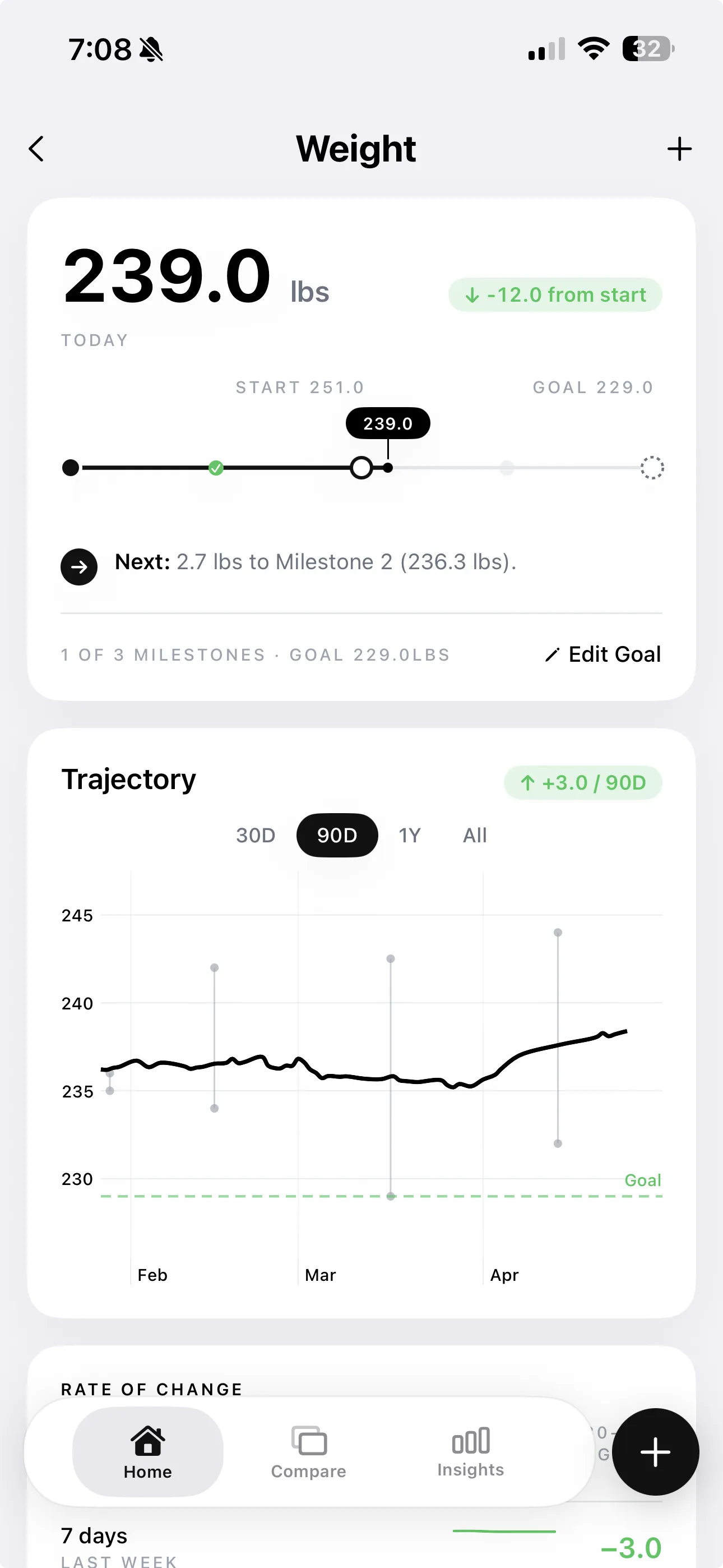
An example weight-history screen from our app. The trend and dates provide context that a single weigh-in cannot.
Who should choose each model?
Choose Body Smart if you mainly want weight, estimated composition and a connected app history. It already serves that routine, and its lower cost leaves room for other training priorities.
Choose Body Comp if the specific additional health metrics are worth the price to you. Read their country-specific descriptions first, and have a plan for seeking medical interpretation when appropriate.
If you want separate arm, leg and torso estimates from a hand sensor, you are considering a different hardware category. Our Withings Body Scan review covers that distinction. Avoid buying Comp on the assumption that “Comp” means it includes every composition feature in the range.
What are this comparison's limitations?
This is a sourced feature comparison rather than a new device trial. Product pages can change, regional features differ, and app services evolve. We have not shown that paying the extra $100 produces better lifting outcomes or more accurate personal body-fat measurements.
Our recommendation follows the verified feature split: start with Body Smart for the common tracking workflow, and pay for Body Comp when its additional measurements are the reason you are buying.
What else should you know?
What is the main difference between Body Smart and Body Comp?
Both cover weight, estimated composition and a connected app history. Body Comp adds vascular age and an electrodermal-activity feature in the US. Those additional health metrics are the main reason to upgrade. Check your regional product page because feature names and availability can differ between markets.
Do Body Smart and Body Comp need Withings+?
Core scale measurements do not require Withings+. The subscription adds optional app services and guidance. Review the offer you select for trial duration and renewal terms, because older launch bundles can differ from current purchases. A subscription benefit also does not add missing measurement hardware to the scale.
Is Body Comp more accurate for body fat than Body Smart?
This guide does not establish that Body Comp has lower individual body-fat error than Body Smart. The added vascular and electrodermal features measure different things. A claim about weight precision cannot be used as an error bound for body composition. Choose based on verified features and keep measurement conditions consistent.
Does Body Comp include an ECG or a handle?
Body Comp is not the handle-equipped Body Scan model and does not record an ECG on the scale. Product comparison pages can show several models together, so match each feature to the correct column. Access to an optional ECG-review service does not mean this scale can capture an ECG.
Can both scales send weight to Apple Health?
Both use the Withings iPhone app to share authorized data with Apple Health. Wi-Fi upload to the Withings account and export into Health are separate steps. Verify a fresh entry and its source for each field you need; proprietary health scores should not be assumed to transfer automatically.
Is Body Comp worth the extra money for lifting?
Body Smart is the simpler recommendation when your main goal is a weight and composition history. Body Comp can be worth the difference if you specifically value its additional health measurements. We have not established that the upgrade improves muscle tracking or training outcomes simply because it costs more.
Which sources support this comparison?
Keep the trend beside your photos
GainFrame is our iPhone app for organizing progress photos and reviewing estimated body-composition trends. Read about the app and its creator, or start your own photo history.
Get GainFrame for iPhone