
Quick answer: "Body rating apps" covers three different things — face raters like Umax, physique scorers that grade how you look, and composition apps that estimate what you're made of. Pick by which question you're asking. And favor a rating that lives in a timeline over one you screenshot once.
You upload a photo, the app says 74, you screenshot it and send it to the group chat. Six weeks and one hard training block later you upload another photo and it says 71. Did you get worse, or did you shoot the first one in bathroom lighting after a shoulder session?
There's no way to answer that, because the app kept nothing. That's the actual dividing line in this category, and it has nothing to do with which model gives the flattering number.
The second problem is that "an app that rates your body" pulls up three unrelated product types in the same search results. One rates your face. One grades your physique against an aesthetic template. One estimates body fat and lean mass and never gives you a score at all. Below is the honest map, plus which apps are worth your time inside each lane.
If you'd rather just get a rating before reading the map: our free AI body rater scores one photo 1–100 across body fat, muscle, proportions, and goal fit — three free ratings, no signup, nothing installed. Disclosure, it's ours; the honest comparison of everything else starts below.
What do body rating apps actually rate?
Three categories, three different questions:
Face raters score facial attributes from a selfie — symmetry, jawline, skin — and suggest changes. Umax invented the mainstream version of this. Nothing below the neck is analyzed.
Physique raters grade how your body looks: a 1–100 number or a tier label built from body fat level, muscle definition, symmetry, and proportions. Our physique rating scale explainer covers what those tiers usually mean.
Composition estimators skip the grading and output biology instead — body fat percentage, lean mass, circumferences. There's no score to chase, which some people strongly prefer.
| App | What it rates | Price | Keeps history? |
|---|---|---|---|
| GainFrame | Physique 1–100 + BF% + 12 muscles | Free (25 photos) / $5.99 mo | Yes — full timeline |
| Umax | Face only | Free / subscription | Re-scan on demand |
| Recomp AI | Composition + circumferences | Free + subscription | Scan to scan |
| Spren | Body fat + BMI reading | Free + subscription | Readings, no photo record |
| One-shot raters | Single body score | Usually free + ads | Rarely |
| Free web raters (ours) | Physique score or BF% | Free | No — one-shot by design |
Which body rating apps are worth using in 2026?
Ordered by how much the rating survives past the day you got it.
1. GainFrame — best if you want the rating to still mean something in October
Platform: iOS App Store · Price: Free (25 photos) with Pro at $5.99/mo or $39.99/yr
Disclosure up front: GainFrame is our app, so read this entry with that in mind and check the others on their own terms. One photo returns a 1–100 physique score, decomposed into body fat, muscle, proportions, and goal fit, plus individual ratings across 12 muscle groups.
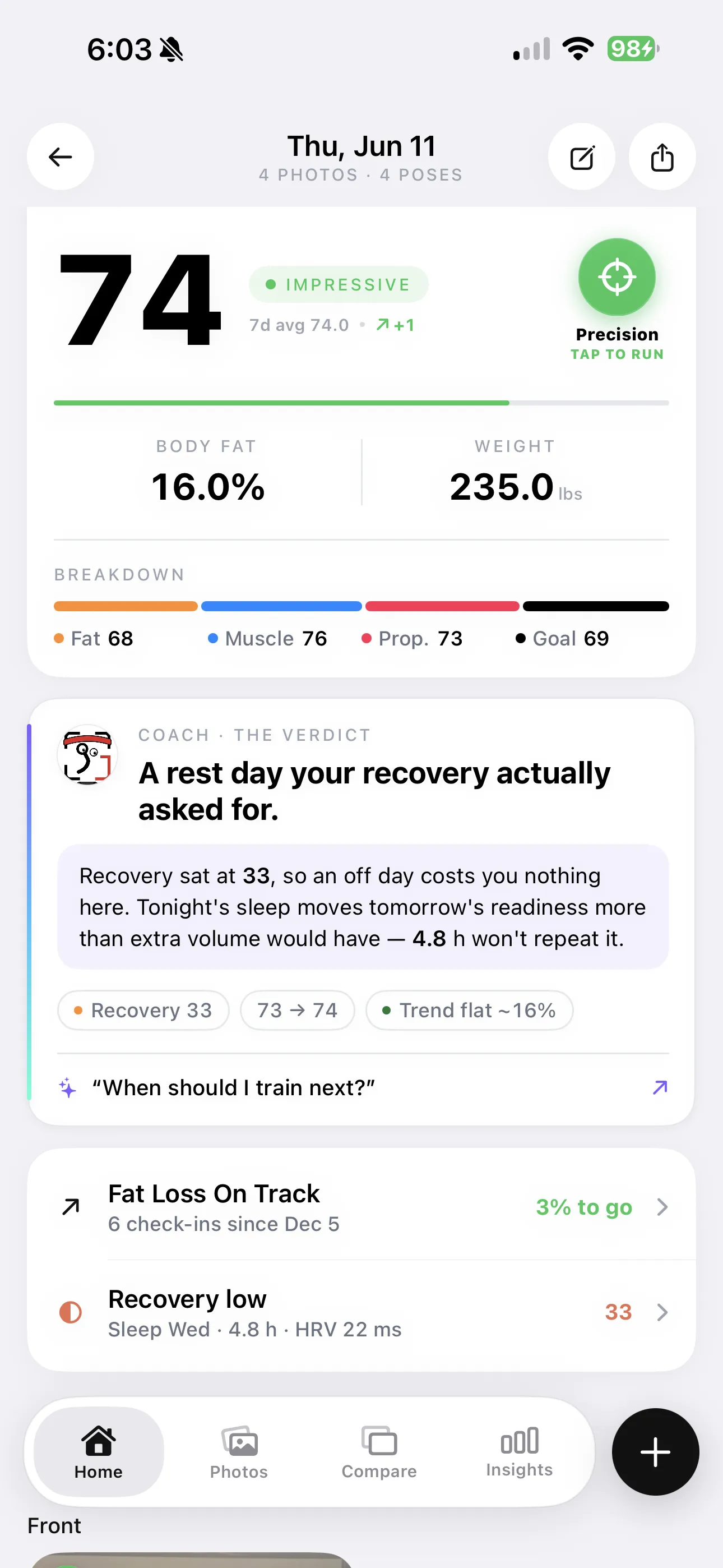
A decomposed rating: the number plus the four things that produced it, so you know what to train.
The part most raters skip is what happens on photo number two. Every score is stored and comparable, so you can pick any two check-ins and see which muscle groups moved tiers and where body fat went. Camera-roll import backfills old gym photos into that history on day one, so the timeline doesn't start empty.
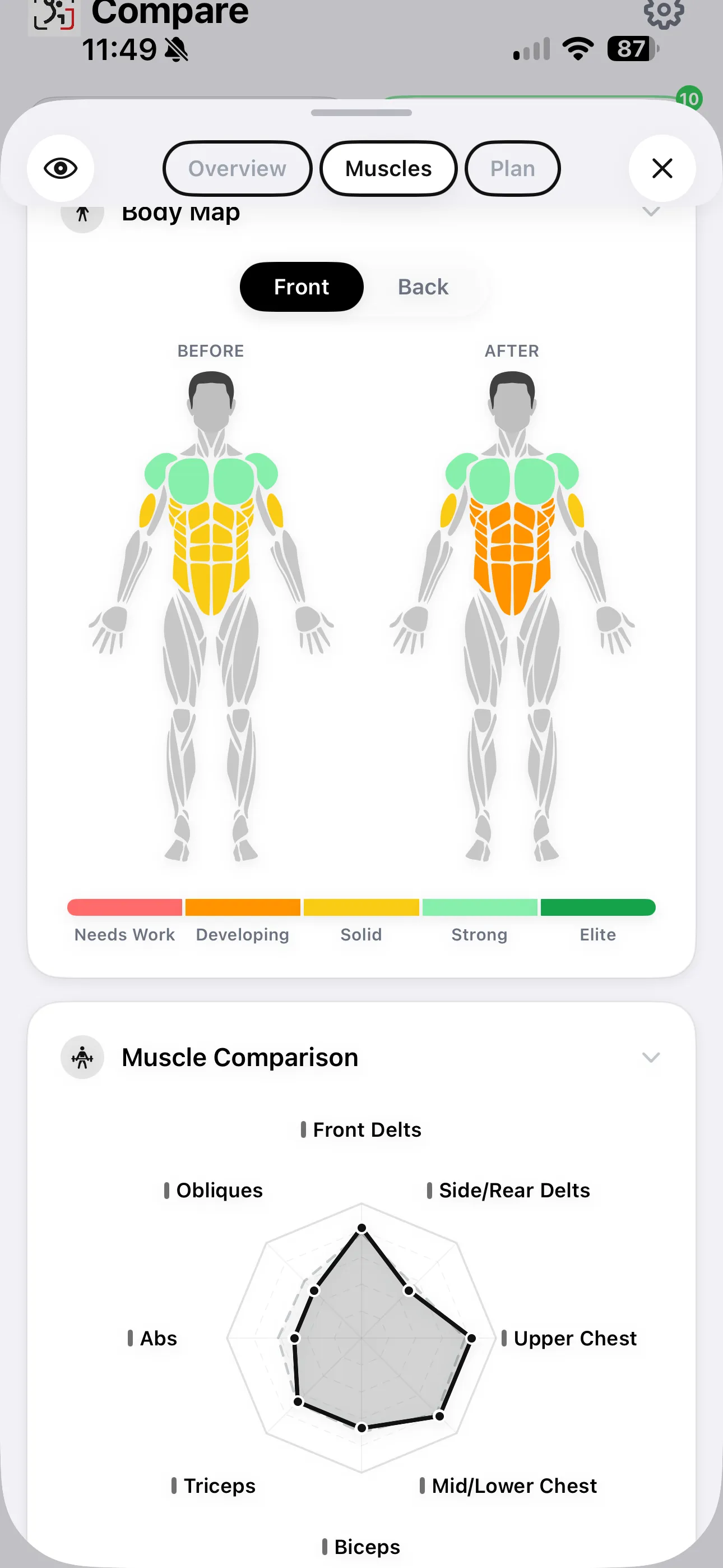
The muscle map — which groups are lagging, which moved, and by how much.
Best for: lifters who want a rating that doubles as a training signal. Limitations: iOS only; the numbers are estimates from photos rather than clinical measurement; free tier stops at 25 analyzed photos.
2. Umax — the face rater people mean when they say "rating app"
Platform: iOS · Price: Free with subscription
Umax belongs on this list because it's the app most people are thinking of, and because it's constantly mistaken for a physique app. It isn't one. Umax analyzes facial attributes from a selfie and returns ratings with improvement suggestions, and with 50,000+ App Store ratings it's the clear category leader for that job.
If face is what you want rated, nothing here replaces it, and running Umax alongside a physique tracker creates zero overlap. Our apps like Umax roundup covers the physique-side equivalents in more depth.
Best for: the looksmaxxing use case it invented. Limitations: no body analysis whatsoever.
3. Recomp AI — best if you'd rather have numbers than a grade
Platform: iOS · Price: Free to download, subscription tiers
Recomp AI, from ISO Labs, scans your body with the phone camera and returns a 3D model with body fat, lean mass, and regional circumference estimates. There's no single score to fixate on, which is genuinely the appeal for some people — you get a readout rather than a verdict.
It holds a 4.7 App Store rating on a smaller review base than the established scanners, and when we tested it the individual scan was stronger than the long-term tracking around it. We compare the two directly in Recomp AI vs GainFrame.
Best for: composition data with circumferences attached. Limitations: newer with a shorter public track record; timeline features thinner than the scan itself.
4. Spren — best fast reading with no photo habit
Platform: iOS · Price: Free to download, subscription
Spren is built for speed to a number: point the camera, get body fat percentage, BMI, and related metrics, close the app. Around 1,500 App Store ratings at roughly 4.7 suggest the flow works for the people it's aimed at, which is general fitness users rather than physique-focused lifters.
The honest caveat from our Spren review: its DEXA-comparable accuracy claims are vendor-published rather than independently validated, and the app is a readout instead of a record — no physique timeline, no muscle-level detail.
Best for: a periodic composition check with minimal ceremony. Limitations: no rating, no visual history, accuracy claims unverified by third parties.
5. One-shot physique raters — fine as entertainment, weak as a signal
Platform: web and iOS, a rotating cast · Price: usually free with ads or IAP
There's a steady supply of "rate my physique" apps and web tools that hand you a single number with no methodology disclosed. They're fun, they're free, and the score expires the second you close the tab because there's nothing to compare it against next month.
Two specific things to watch. Accuracy claims in the 90s with no published validation are marketing copy, and some of these tools upload your photo to a server without saying clearly what happens to it afterward. Our AI physique rating apps roundup tests the current crop individually if you want the app-by-app detail.
Best for: curiosity, once. Limitations: no history, no methodology, variable privacy handling.
6. Free web raters — best zero-commitment first read (ours)
Platform: any browser · Price: Free
Same disclosure: these are ours. The free physique rater runs the same four-part framework — body fat, muscle, proportions, goal fit — on one photo, three free ratings, no signup. The body fat estimator gives you the single number behind it, three free scans at one per day.
They're deliberately one-shot. No timeline, no muscle scoring, nothing to log into. The useful move is running the same photo through one of these and one other free tool — if two independent models land within a couple of points of each other, the neighborhood is probably right.
Best for: trying the scoring before installing anything, or cross-checking another tool's estimate. Limitations: one photo at a time, no record kept, daily cap.
Why does a trackable rating beat a one-shot score?
Because a single score has nothing to be measured against except your mood that day.
A rating you can track fixes three specific problems. It gives you a baseline, so the second number is interpretable. It applies the same methodology to photo one and photo fifty, so the change you see is a change in you and not a change in the model. And it lets the score decompose over time — which muscle group moved, how much body fat came off — instead of collapsing everything into one digit.
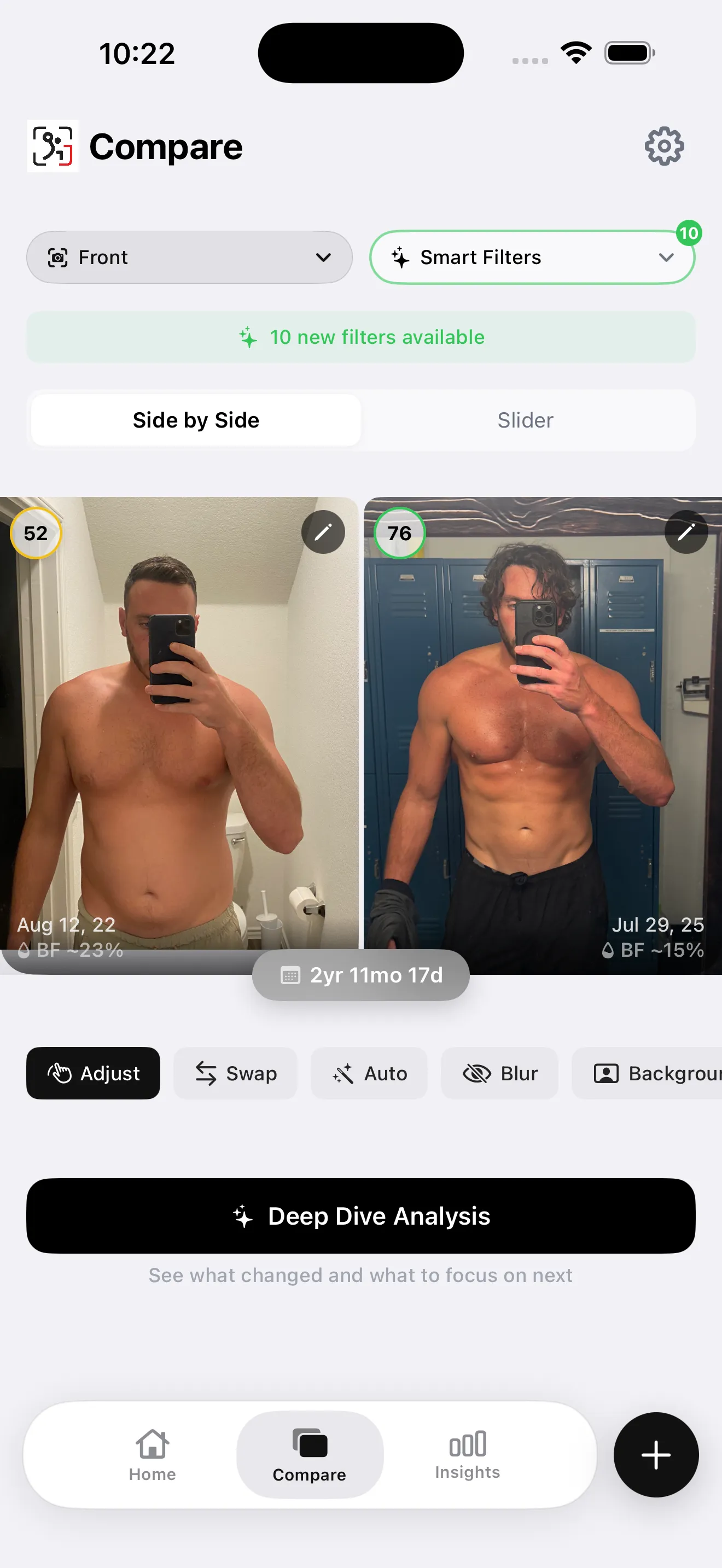
The comparison a one-shot rater can't do: same scoring system on both photos, with the delta stated.
The counterargument is fair — some people find any score bad for their head, and a number with no context can feed fixation. Framing it as your score against your own last month rather than against other people is what usually keeps it useful. If it stops being useful, drop the number and keep the photos.
How do you get a rating you can actually compare?
- Pick one app and stay in it for at least eight weeks. Switching mid-block resets your baseline, and every scoring system is its own reference frame.
- Standardize the photo. Same lighting, same room, same time of day, same distance, same clothing. Vision models notice all of it.
- Re-shoot every 4–8 weeks and read direction, not magnitude. A three-point jump inside two weeks is noise; six weeks of drift in one direction is signal.
- Cross-check the absolute number once. Run one photo through a second free tool. Agreement means the neighborhood is right; a wide gap means treat the number loosely and watch the trend instead.
If you want the deeper background on what a 1–100 physique number is built from, our guide to the AI physique score walks through the components, and rate my physique covers what to expect the first time you get scored.
Frequently asked questions
What is the best app that rates your body?
It depends which body you mean. For your physique, GainFrame scores a photo 1–100 and breaks it into body fat, muscle, proportions, and goal fit, plus ratings for 12 muscle groups that carry forward in a timeline. For your face, Umax leads that category. For composition numbers without a score, Recomp AI and Spren both estimate from a camera scan.
Does Umax rate your body or just your face?
Umax rates faces only. It analyzes a selfie across facial attributes and returns ratings with suggestions, which is why it became the app behind the looksmaxxing trend. It does not analyze your physique, muscle development, or body composition at all. If you want your training assessed, you need a physique-focused app, and the two do not overlap.
Are body rating apps accurate?
Treat any single score as directional. Vision models reliably separate a lean physique from a high-body-fat one, and get shakier at the margins where two points of body fat are the difference. Very few rating apps publish validation data, so accuracy claims in the 90s should be read as marketing. Consistency between your own photos matters more than the absolute number.
Is there a free app that rates your body?
Yes, with caps. GainFrame's free tier scores 25 photos lifetime on iOS, which is the most detailed free rating we know of. Free browser tools give you a one-shot read with no install, including our own physique rater and body fat estimator. Ad-supported one-shot raters are free too, but they rarely keep any history.
How often should you re-rate your body?
Every four to eight weeks. Body fat moves roughly half a point to a point per month in a deficit, and muscle gain is slower than that, so anything inside two weeks is mostly lighting, hydration, and pump. The longer gap also forces you to actually finish a training block before you go looking for a verdict on it.
Get a rating that still means something next month
GainFrame scores your photo 1–100, breaks it into body fat, muscle, and proportions, rates 12 muscle groups, and keeps every score so the next one has something to be compared against. Free tier covers 25 photos on iOS.
Download GainFrame Free