
Quick answer: "Physique rating" means different things by scale. Gym body composition machines commonly output a 1 - 9 rating; AI apps typically score 1 - 100; competition judging grades size, conditioning, and symmetry. Any useful scale decomposes into body fat, muscle mass, and proportion - and only means something compared against your own past number.
You step on the body composition scale at the gym and it prints a "physique rating: 5." Later that week an app scores the same body 68 out of 100. Someone in a comment section calls it a 6/10. Three numbers, same body, same day.
None of them are lying. They're grading different things on different scales with different reference points, and almost nobody explains which is which. This page covers the scales you'll actually encounter, what each one is built from, and how to read your own number without it being useless or corrosive.
Two related pages cover the neighboring questions: our breakdown of the 1 - 100 physique score documents how one specific AI score is calculated, and the AI physique rating apps roundup tests the apps that hand these numbers out. This page is about the concept underneath all of them.
You can try the free physique check to see a score with four sub-scores and explanatory feedback. Keep your photo conditions consistent when comparing results.
What is a physique rating actually rating?
Every physique scale is a compression algorithm. It takes a handful of underlying facts about your body - how much fat you carry, how much muscle, how it's distributed - and squeezes them into one number so you can compare today against last month without reading a spreadsheet.
That compression is the whole value and the whole problem. One number is easy to remember and easy to track. One number also can't tell you why it moved, which is the part you'd need to change anything.
So the honest test of any rating scale isn't "is the number right." It's whether the number can be unpacked back into the inputs that produced it.
What are the different physique rating scales?
Four scales dominate, and they overlap less than you'd think.
| Scale | Where you meet it | What it's built from | Useful for |
|---|---|---|---|
| 1 - 9 physique rating | BIA body composition machines | Estimated body fat + muscle mass | A coarse category check |
| 1 - 100 physique score | AI photo apps | Body fat, muscle, proportions, goal fit | Month-to-month tracking |
| Competition criteria | Physique/bodybuilding judging | Size, conditioning, symmetry, presentation | Stage prep, photoshoot prep |
| 1 - 10 social rating | Comment sections, forums | Whoever is typing | Nothing |
The first three are trying to measure something. The fourth is a mood. Worth separating before you let any of them affect your training.
What does the 1 - 9 physique rating on a body composition scale mean?
If you've used a Tanita-style machine - the ones common in commercial gyms, and the software behind many consumer BIA scales - you've probably seen a "physique rating" between 1 and 9 next to your body fat percentage.
The mechanism is simpler than it looks. The machine estimates your body fat and your muscle mass, then drops that pair onto a nine-cell grid: low/medium/high fat crossed with low/medium/high muscle. Each cell has a label, generally running from something like "thin" through "standard" to "muscular." Implementations vary between manufacturers and firmware versions, so treat the exact labels on your machine as its own vocabulary.
Two things follow from that. The rating adds no information your body fat and muscle mass numbers didn't already contain - it's a lookup, not a separate measurement. And it's coarse: you can drop several pounds of fat and stay in the same cell all cut, which feels like no progress when the underlying numbers actually moved.
Worth remembering that the inputs themselves are estimates. BIA readings swing with hydration, food, and time of day, which is why smart scale accuracy is a live debate. A rating derived from a noisy input inherits the noise.
What does a 1 - 100 AI physique score measure?
The app-side convention is a 1 - 100 score from one or more photos. The extra resolution is the point: on a 100-point scale, a real month of training can visibly move the number, where a 9-point grid would have stayed put.
What goes into it varies by app, but the better implementations decompose the score rather than just emitting it - body fat level, muscle development, proportions and symmetry, and sometimes fit against your stated goal, since a good number for someone bulking isn't the same as a good number for someone eight weeks into a cut.
The catch is that resolution and accuracy are different properties. A score of 68 versus 71 looks precise, but if both came from single photos taken under different lighting, the difference between them may be entirely photographic. Most photo-based estimates land within a few percentage points of clinical body fat measurement for typical users - good enough for trends, not good enough to treat a three-point score gap as fact.
What do competition judges actually score?
Physique and bodybuilding judging is the oldest rating scale here, and it's the most explicit about what it values: muscular development, conditioning (how lean and how visibly detailed), symmetry between left and right, proportion between body parts, and presentation on stage.
It's also the least applicable to most people reading this. Judging criteria are calibrated to a stage population at contest-day leanness - commonly single-digit body fat for men - and they weight presentation, which has nothing to do with your body composition. Borrowing the criteria as a checklist is useful. Borrowing the scoring is not.
The genuinely portable idea from judging is that proportion is scored separately from size. A lagging body part costs you points even when the total mass is impressive, which is exactly the information a single overall number hides.
Why is the 1 - 10 social rating meaningless?
Because there's no rubric, no reference population, and no consistency between raters - and the same photo scores differently depending on who's typing, what else they've scrolled past that hour, and what the comment above them said.
There's also a mechanical problem: informal ratings compress everything into a narrow band. In practice almost everything lands between 4 and 8, so the scale has maybe five usable values covering the entire range of human bodies. You could hold a 6/10 through an entire successful cut.
Then there's the part that actually matters. A number from a stranger is an opinion delivered in the costume of a measurement, and it lands harder than an opinion because it looks objective. If you want an outside read on your physique, there are better ways to get one.
What should a good physique scale measure?
Strip away the packaging and three inputs do nearly all the work in any credible physique rating:
- Body fat level. The single biggest driver of how a physique reads. Our body fat percentage chart covers what each range typically looks like.
- Muscle mass relative to your frame. Absolute mass means little without height context, which is why FFMI percentiles are a more useful lens than raw lean pounds.
- Proportion and symmetry. Shoulder-to-waist, upper-to-lower balance, left-versus-right - the part that separates two people at identical body fat and identical mass.
A scale that reports all three separately is doing something a single number can't. A scale that reports only the composite is asking you to trust the weighting it chose, which is generally undocumented.
What does a rating change actually look like?
Ten points of body fat is roughly what a serious cut delivers over several months, and it's the change most likely to move any physique rating you're tracking. Here's what that magnitude looks like on one body - these are standardized, photorealistic AI renders from our body fat visualizer, same build, pose, and lighting, so only body fat differs between the images.
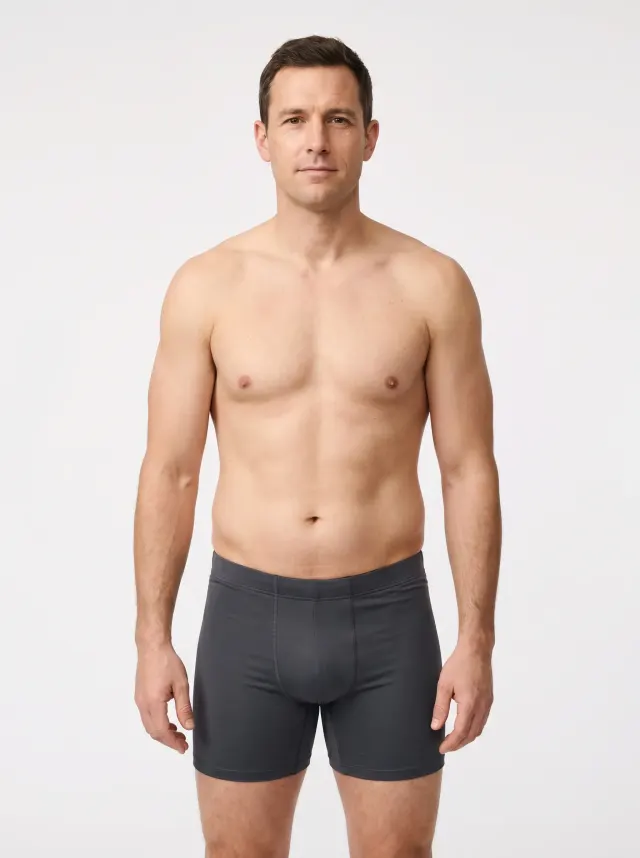
23% body fat. Muscle is present but buried - most rating scales would land this in a middle or lower-middle band.
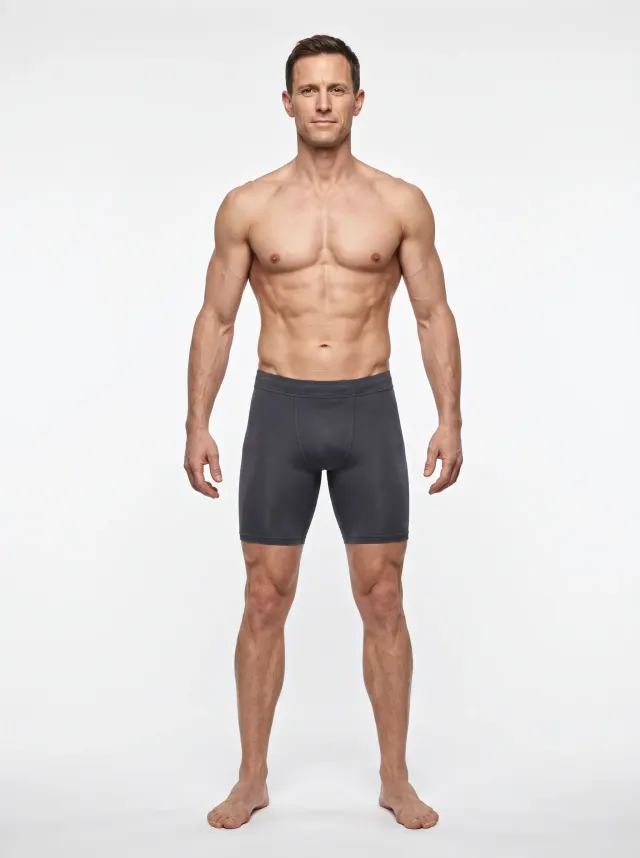
The same frame at 13%. Identical muscle mass, ten points of body fat removed - and every scale on this page reads it differently.
Notice what didn't change: the muscle underneath is the same. That's the useful reminder about ratings. A big score jump usually means the fat came off, not that you built a new physique - and a rating that can't tell you which of the two happened isn't much of a rating.
How should you read your own number?
Compare it to your own past number, under matched conditions, and to nothing else. Same scale, same time of day, same hydration state for BIA; same lighting, distance, pose, and time of day for photos. A rating compared against a stranger's rating on a different device in different lighting is not a comparison at all.
Then ask the decomposition question. If the number went up, which input moved - did body fat drop, did muscle scores rise, did proportions shift? A scale that can answer that is a training tool. One that can't is a scoreboard.
GainFrame is built around that second question: each photo gets a 1 - 100 score broken into body fat, muscle, proportions, and goal fit, plus individual ratings across 12 muscle groups, so a moving number always comes with the reason it moved. Estimates from photos, not clinical measurement - but applied consistently, which is what a trend needs. If you'd rather not install anything, the free body fat estimator returns the single biggest input on its own.
Frequently asked questions
What is a physique rating?
A physique rating is any scale that grades how your body looks rather than what it weighs. The common versions are the 1 - 9 rating printed by many body composition scales, the 1 - 100 score most AI photo apps output, and competition judging criteria. All of them are trying to compress body fat, muscle mass, and proportion into a single number you can act on.
What does the 1 - 9 physique rating on a gym scale mean?
Tanita-style body composition machines commonly map your estimated body fat and muscle mass onto a nine-cell grid with labels like thin, standard, and muscular. It's a lookup table rather than a separate measurement - two people with identical readings get identical ratings. The underlying body fat and muscle numbers are more informative than the tile they land in.
Is a 1 - 100 physique score better than a 1 - 10 rating?
More resolution isn't automatically more accuracy. A 1 - 100 score can express smaller changes than a 9-point grid, which matters when you're tracking month to month. But a 100-point score built on one photo still carries all the error of that photo. Extra resolution only helps when the method behind it stays consistent between readings.
What is a good physique rating?
There's no universal good. On a 1 - 9 body composition rating, the middle-to-upper cells generally indicate lower body fat paired with average-or-higher muscle mass. On a 1 - 100 AI score, most consistently trained lifters land somewhere in the middle band. The more useful question is whether your own number moved in the direction you were training for.
How often does a physique rating change?
Slowly. Body fat commonly moves around 0.5 - 1% per month in a deficit and muscle gain is slower still, so meaningful rating changes take roughly four to eight weeks. Anything that swings inside a week is usually lighting, hydration, pump, or time of day. Re-rate monthly and read the direction rather than the single reading.
Get a number that unpacks
GainFrame scores your progress photos 1 - 100 - decomposed into body fat, muscle, proportions, and goal fit, with ratings across 12 muscle groups so you can see which input moved. Free tier covers 25 photos; Pro is $5.99/month or $39.99/year. iOS.
Download GainFrame Free