
Quick answer: Body recomposition — losing fat and building muscle at the same time — works after 40. Muscle responds to resistance training at every age studied, per commonly reported research on older adults. What changes is recovery: you need more spacing between hard sessions, slightly more protein, and more patience with the timeline.
Search "building muscle after 40" and you get two kinds of content. Doom pieces telling you your testosterone fell off a cliff at 35 and it's maintenance mode from here. And supplement ads telling you one pill fixes the doom. Both are selling something, and neither matches what resistance-training research on older adults commonly reports.
Here's the version with no product behind it: a 45-year-old who lifts three times a week and eats 160 grams of protein a day will, over 12 months, almost certainly out-build a 25-year-old who does neither. Age is one variable. Training is a much bigger one. This page covers what genuinely changes after 40, what doesn't, and the short list of adjustments that actually matter.
What actually changes after 40?
Three things, honestly stated. None of them is a wall.
Recovery capacity shrinks. The workout you could repeat every 48 hours at 28 may need 72 hours at 48. This is the most commonly reported and most practically important change — the muscle still adapts, it just needs more time between hard stimuli to do it. Ignoring this is how over-40 lifters end up with the nagging elbow or shoulder that costs them three months.
Untrained muscle drifts away. Research on aging commonly reports gradual muscle loss starting somewhere in the 30s or 40s for people who don't train — figures on the order of a few percent per decade are often cited, accelerating later in life. Read that sentence carefully, though: it describes people who don't train. Resistance training is the single best-documented countermeasure, which reframes lifting after 40 from vanity project to the closest thing to an anti-aging intervention with real evidence behind it.
Hormones drift. Testosterone in men commonly declines gradually from the 30s onward, and perimenopause changes the hormonal picture for women — our menopause and body composition guide covers that side in depth. For most people this drift is gradual and doesn't prevent progress. If you suspect something beyond normal drift — energy, libido, and recovery all cratering together — that's a conversation for a doctor with bloodwork, and nothing you should self-diagnose from a blog post, this one included.
What doesn't change after 40?
The part the doom content leaves out: the fundamental response is intact.
Resistance-training studies on older adults — and "older" in this literature often means 60s and 70s, well past you — commonly report meaningful gains in muscle size and strength at every age studied. The signal pathway from lifting heavy things to building muscle does not have an expiration date that anyone has found. It attenuates somewhat; it does not switch off.
Fat loss math doesn't change either. A calorie deficit works the same at 48 as at 28. Metabolism slows less with age than commonly believed — much of the commonly cited "metabolic slowdown" appears to track lost muscle and reduced activity rather than age itself, which means training directly attacks the cause.
And the recomp mechanism itself — building muscle while losing fat, covered in our bulk, cut, or recomp guide — arguably works better in the typical over-40 starting position. Recomp responds best in people who are newer to training, returning after a layoff, or carrying higher body fat. That describes most people picking this back up at 45 far better than it describes a 24-year-old with three years of consistent lifting.
What adjustments actually matter over 40?
Four levers, in rough order of importance. Notice that none of them is a supplement.
Space out the hard sessions. Three full-body sessions a week with a rest day between each beats five consecutive days of body-part splits for most over-40 lifters. You're managing a smaller recovery budget — spend it on fewer, harder, better-recovered sessions rather than more frequent, half-recovered ones.
Push protein slightly higher. Commonly cited lifter guidance is 0.7–1 gram per pound of body weight daily; recommendations for older adults often sit at the top of that range, because research commonly reports that the muscle-building response to a given protein dose blunts somewhat with age. Practically: distribute it across 3–4 real feedings rather than one big dinner.
Pick joint-friendly variations and drop the ego sets. The stimulus that builds muscle is challenging sets near failure — the specific exercise is negotiable. If low-bar back squats bother your hips, leg press and split squats build the same quads. Trap-bar deadlifts, dumbbell presses, chest-supported rows: same stimulus, friendlier angles. The best exercise after 40 is the one you can still be doing at 50.
Guard sleep like a training variable. Recovery happens in the hours you're not training, and sleep is where most of it lives. Seven-plus hours is commonly cited as the threshold below which training adaptations and appetite regulation both degrade. An extra hour of sleep will do more for your recomp than any product with "test" in the name.
Why is recomp the right approach over 40?
Because the alternatives each pick a fight with your weakest attribute.
An aggressive cut — large deficit, fast scale drop — carries a commonly reported risk of losing muscle along with fat, and that risk grows when recovery is already limited. At 45, muscle is precisely the asset you can least afford to burn. An aggressive bulk has the opposite problem: the extra fat goes on easily and, with a slower metabolism of activity and less recovery headroom for the eventual cut, comes off harder.
Recomp is the middle path that respects the constraint. Eat near maintenance, keep protein high, train progressively, and let the composition shift underneath a nearly flat scale weight. It's less dramatic than either extreme, and it's sustainable in the way a 12-week shred never is — which matters more at this age, because the over-40 win condition is measured in years of consistency, and the plan you can hold for years beats the plan that impresses for twelve weeks.
Here's what the target actually looks like. These are standardized, photorealistic AI renders from our body fat visualizer — same build, pose, and lighting, so only body fat changes between images. Both show a man in his 40s.
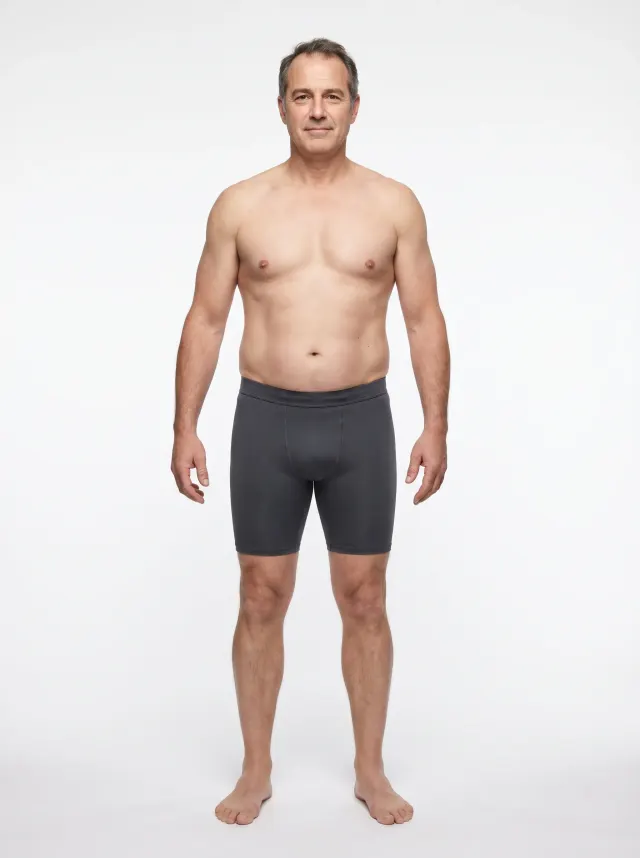
23% body fat — a common over-40 starting point. Some muscle underneath, softness over it, waist starting to lead the silhouette.
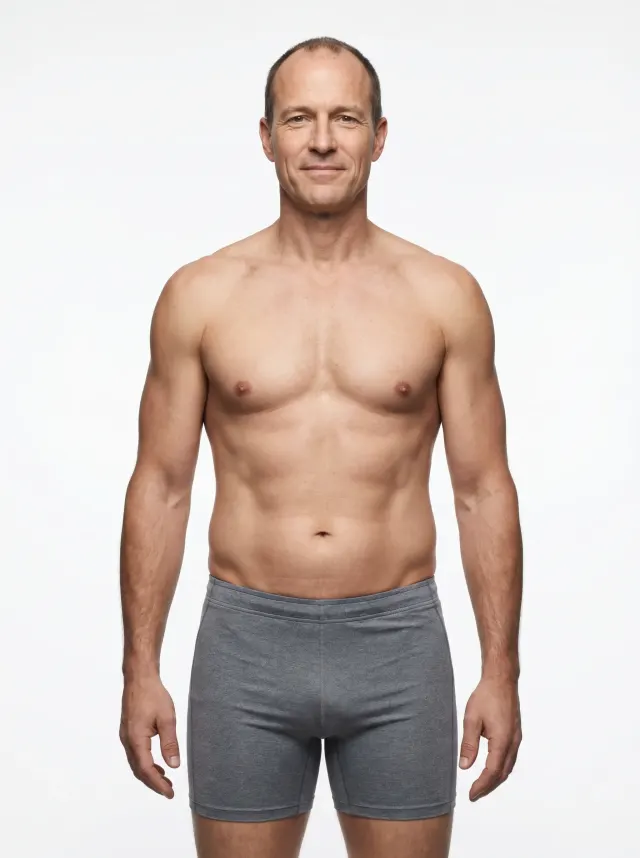
The same frame at 18% — shape visible, waist narrower, and every pound of muscle now shows. A realistic 6–12 month recomp outcome.
Five body fat points on the same frame. That's an unglamorous, entirely achievable over-40 recomp — and it reads as a different person in a t-shirt.
How do you track recomp when change is this slow?
This is where over-40 recomp actually gets hard. The process works; the feedback loop is miserable.
The scale is nearly useless during recomp — fat leaving and muscle arriving can net out to zero, a pattern our losing inches but not weight guide breaks down. The mirror is worse, because daily inspection can't detect change that accrues over months. And over 40, with the timeline stretched further by slower recovery, both problems compound. People quit working plans constantly because their measurement tools couldn't see the progress.
The fix is measurement matched to the timescale: monthly progress photos under identical conditions — same spot, same light, same morning timing — plus a waist measurement, compared across months rather than days. Our recomp before-and-after timeline shows what 3, 6, and 12 months of this actually look like, and why the 3-month mark is where most people wrongly conclude nothing is happening.
GainFrame was built for exactly this feedback problem — it estimates body fat percentage, FFMI, and per-muscle ratings from progress photos, so a slow recomp shows up as a trend line instead of a memory test. Estimates from photos rather than clinical measurement, but consistent check-in to check-in, which is what a months-long trend needs. Everything runs on-device with no account, and photos are never stored on a server.
Frequently asked questions
Can you build muscle after 40?
Yes. Resistance-training research on older adults commonly reports meaningful muscle growth at every age studied, including well past 60. The response per unit of training may be somewhat slower than in your 20s, and recovery takes longer, but the machinery still works. The people who lose muscle after 40 are overwhelmingly the ones who stopped training it.
Is body recomposition harder after 40?
Somewhat, and mostly through recovery rather than the muscle itself. You generally need more spacing between hard sessions, sleep matters more, and visible change arrives more slowly. The process is the same — lift progressively, eat enough protein, hold a modest calorie position — it just runs on a longer clock and punishes skipped recovery harder.
How much protein do you need for recomp over 40?
Commonly cited guidance for lifters lands around 0.7–1 gram per pound of body weight daily, and recommendations for older adults often sit at the higher end of that range because the muscle-building response to a given protein dose appears to blunt somewhat with age. For a 190-pound man, that's roughly 130–190 grams per day.
Should you bulk and cut or recomp after 40?
For most people over 40 carrying some extra fat, recomp is the better fit. Aggressive cuts risk more muscle loss when recovery is slower, and aggressive bulks add fat that's harder to remove later. A recomp — training hard while eating near maintenance with high protein — moves both levers at a pace your recovery can actually support.
How long does body recomposition take after 40?
Expect the commonly cited recomp timeline — visible change around 3 months, obvious change around 6 — to stretch somewhat. Slower recovery means slower accumulation of productive training. That's an argument for better tracking, since day-to-day mirror checks can't detect change this gradual. Monthly photos taken under identical conditions can.
Make slow progress visible
GainFrame estimates body fat percentage and physique scores from your progress photos — so a months-long recomp shows up as a trend you can see, not a feeling you have to trust. Free to start on iOS.
Download GainFrame Free