
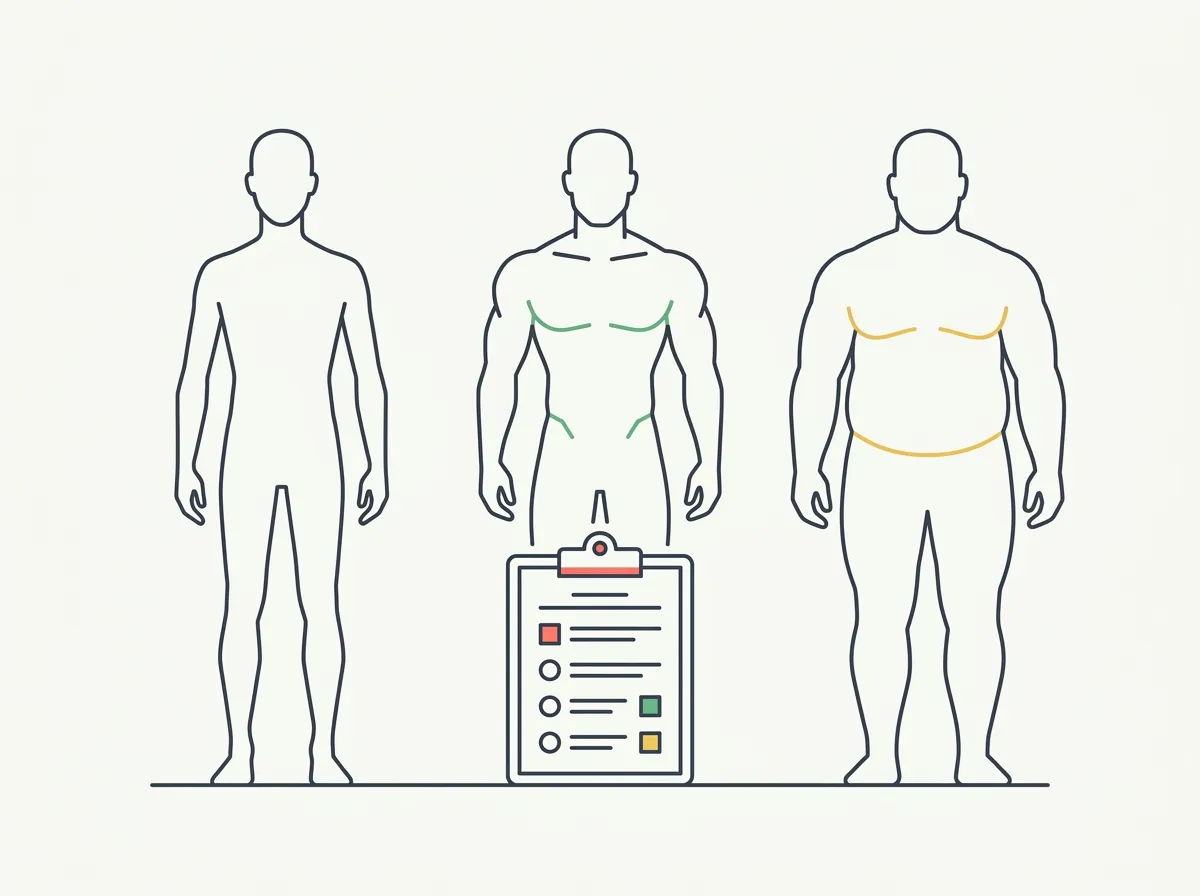
Quick answer: Answer six questions about wrist size, weight history, appetite, and training response. Mostly A suggests an ectomorph-ish (hard-gainer) tendency, mostly B mesomorph-ish, mostly C endomorph-ish. Most people score a blend — and the categories only set your calorie starting point. The training fundamentals stay the same for all three.
You've seen the labels everywhere: ectomorph, mesomorph, endomorph. Half the fitness internet wants to sort you into one before it will tell you what to eat, and usually there's an email gate between you and your "result."
Here's the quiz without the gate — six questions, score yourself with a pen or your memory, done in two minutes. And then the part most body type quizzes skip: where these categories actually came from, what they can and can't tell you, and the one practical thing your result should change.
How does this body type quiz work?
Each question has three answers. A leans ectomorph, B leans mesomorph, C leans endomorph. Tally your letters at the end — no JavaScript, no signup, no "enter your email to unlock your somatotype."
Answer from your lifetime history rather than your current state. If you're carrying extra fat right now after two sedentary years, questions about lifetime tendency should reflect the lifetime, since that's what the quiz is trying to read.
The six questions
| Question | A | B | C | |
|---|---|---|---|---|
| 1 | Wrap your thumb and middle finger around your opposite wrist. What happens? | They overlap | They just touch | They don't meet |
| 2 | Left alone — no diets, no programs — where does your weight naturally sit? | Thin, almost regardless of eating | Middle, with some natural shape | Heavy side; gaining is the default |
| 3 | When you've eaten more and trained, what showed up first? | Barely anything; gaining is a grind | Muscle, relatively quickly | Fat, faster than muscle |
| 4 | How do your limbs read in the mirror? | Long and lanky, narrow shoulders | Proportional, shoulders wider than waist | Shorter relative to torso, thicker joints |
| 5 | What's your appetite like most days? | Forgettable — meals slip your mind | Steady, roughly tracks activity | Big — stopping is the hard part |
| 6 | If you've trained before, what did the first months do? | Strength rose, the scale barely moved | Visible muscle within a couple months | Strength rose, softness stayed |
Count your A's, B's, and C's, then find your row.
What does your score mean?
| Result | Tendency | Practical read |
|---|---|---|
| 4+ A's | Ectomorph-ish | Hard-gainer: small frame, fast metabolism impression, gaining takes deliberate eating |
| 4+ B's | Mesomorph-ish | Responsive middle: builds muscle readily, tolerates surplus reasonably well |
| 4+ C's | Endomorph-ish | Easy-gainer: wider frame, surplus turns to fat quickly, deficits feel harder |
| Anything split | Blend | The most common result — standard programming fits you as written |
Hold that result loosely, because the next section is the part of this quiz that matters more than your letters.
Where did these body types actually come from?
The somatotype system is commonly traced to William Sheldon, a psychologist working in the 1940s. His project sorted photographs of college students into three physique dimensions — ectomorphy, mesomorphy, endomorphy — and then tried to link each shape to a personality type. The personality half has been largely discarded, and even the physique half scored everyone on all three dimensions at once. Nobody in the original system was simply "an ectomorph."
Fitness culture kept the three names, dropped the nuance, and built diet plans on top. So it's worth being precise about what survives scrutiny. Frame differences are real: wrist circumference, shoulder width, and limb proportions vary between people and don't change. Appetite and weight-gain tendency are real, and anyone who has watched one friend forget lunch while another fights every surplus knows it. The clean three-box sorting, and especially the claim that each box needs its own secret training method, is where the evidence commonly runs out.
That's why the quiz above scores you as ectomorph-ish rather than stamping a category on you. It reads real tendencies through a simplified lens. Most people land in a blend, which was true even in Sheldon's data.
So what should your result actually change?
One thing: the calorie dial. The training fundamentals are identical for every frame that has ever walked into a gym — progressive overload, adequate protein, and enough patience to let months pass. Your quiz result adjusts none of that. It adjusts how you eat around it.
Mostly A's (hard-gainer): your bottleneck is nearly always food. Strength work without a calorie surplus leaves you stronger and identical, which is the classic hard-gainer plateau. Set a deliberate surplus of roughly 200–400 calories a day and defend it as seriously as your training. The case for keeping that surplus small instead of "eating everything" is laid out in lean bulk vs dirty bulk.
Mostly C's (easy-gainer): your bottleneck is the opposite edge of the same dial. You'll build muscle fine, and an unwatched surplus will bury it under fat faster than an A-scorer's would. Keep any surplus small and audited, and check your starting point first — if you're carrying meaningful fat now, run the should I bulk or cut quiz before adding calories at all.
Mostly B's or a blend: standard advice as written. Eat near maintenance or a small surplus depending on your goal, train progressively, and adjust based on results. The decision logic between the three diet approaches is in bulk, cut, or recomp. If your blend leans soft-and-undertrained, the skinny-fat self-check is the more useful sorting question than any somatotype.
One more honest note for the A-scorers convinced their genetics cap them: frame size affects where you start and how fast you gain, and FFMI percentile data shows the ceiling for a consistent natural lifter sits far above where almost anyone quits.
What should you track instead of your type?
A category you tested into once tells you nothing next month. The number that actually answers "is my plan working for my body" is your composition trend — body fat percentage and muscle moving in the right directions over weeks.
The cheap version: a monthly relaxed photo in the same spot and lighting, compared against a body fat percentage chart, plus a waist measurement at the navel. That alone beats every somatotype quiz ever written, because it measures your actual response instead of your presumed category.
The instrumented version: GainFrame analyzes those check-in photos and returns an estimated body fat percentage, FFMI, and a 1–100 physique score with muscle-group ratings, so a hard-gainer can watch lean mass tick up and an easy-gainer can catch a surplus going sideways within a few weeks. Estimates from photos rather than clinical measurement, iOS only, and the free tier covers 25 photos — enough for months of monthly check-ins.
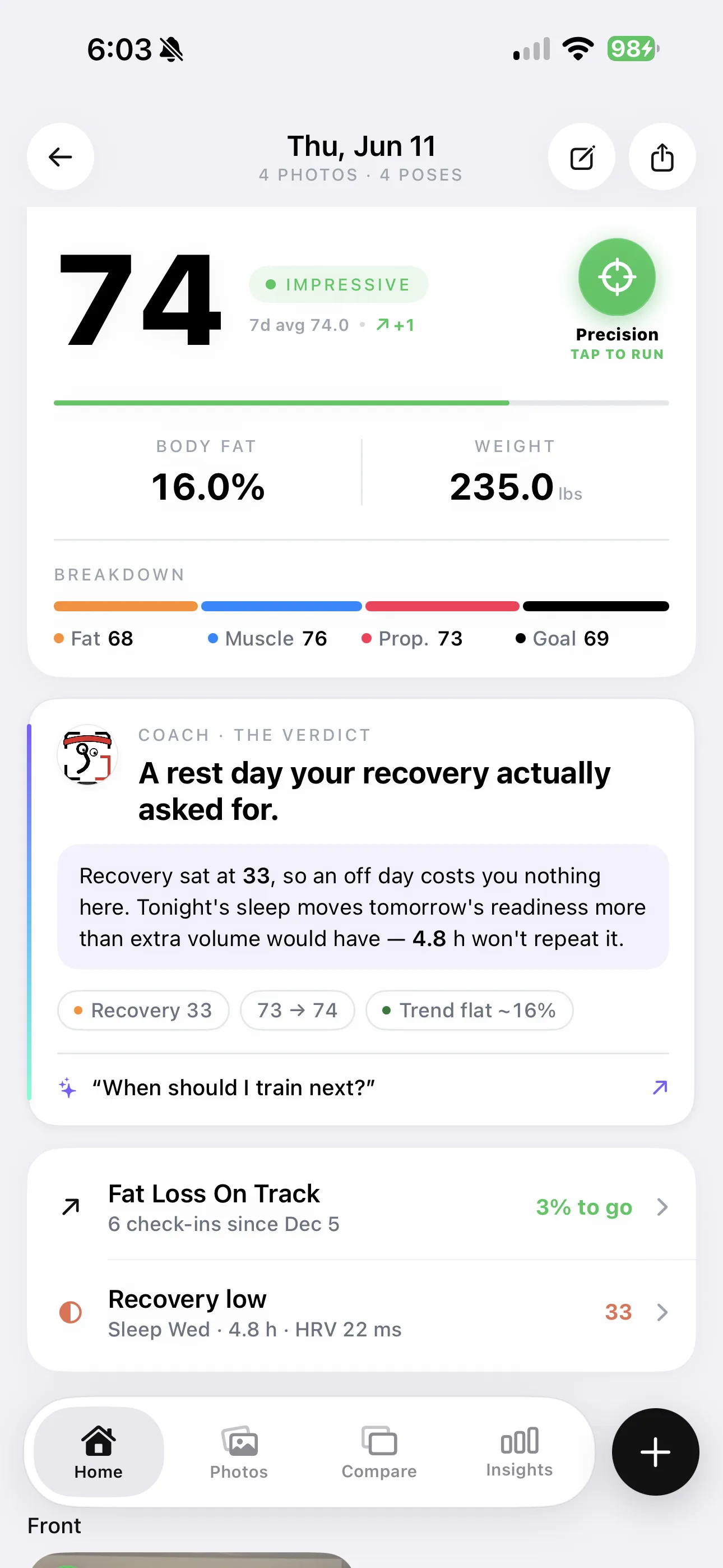
A quiz labels you once. A scored photo trend shows whether your plan is working for your actual body.
Frequently asked questions
What are the three body types?
The traditional somatotype model describes ectomorphs (lean, long-limbed, hard to gain weight), mesomorphs (naturally muscular, gain muscle easily), and endomorphs (wider frame, gain fat easily). The system is commonly traced to 1940s psychology research rather than modern physiology, and most people show a blend of the three rather than one clean category.
Is the ectomorph, mesomorph, endomorph test scientifically valid?
Only loosely. The somatotype framework is commonly traced to William Sheldon's 1940s work, which tried to link body shape to personality and has been largely discarded in that form. Frame size, appetite, and weight-gain tendency are real and observable. The three-category packaging is a simplification, and no rigorous evidence shows each type needs its own training system.
Can your body type change?
Your skeleton is fixed — wrist size, shoulder width, and limb proportions won't move. Nearly everything the quiz measures on top of that can change. A hard-gainer who eats and trains consistently for two years reads as muscular; an easy-gainer who manages calories reads as lean. Composition responds to behavior even though the frame underneath it stays put.
Should ectomorphs train differently than endomorphs?
Mostly no. Progressive overload, adequate protein, and consistency drive muscle growth for every frame, and no body type is exempt from them. What legitimately differs is the calorie side: hard-gainers usually need a deliberate surplus to grow, while easy-gainers need a tighter rein on surplus size. Same training, different dial on the food.
What if I don't fit one body type?
That's the most common result, and it's expected. Even Sheldon's original system scored people on all three dimensions at once rather than sorting them into single boxes. A split score usually means standard advice fits you fine: train progressively, eat near maintenance with adequate protein, and adjust calories based on what your measurements do over a month.
Track your response, skip the label
GainFrame scores your progress photos — estimated body fat, FFMI, and a 1–100 physique score — so you can see how your body actually responds to training instead of guessing from a category. Free to start on iOS.
Download GainFrame Free