
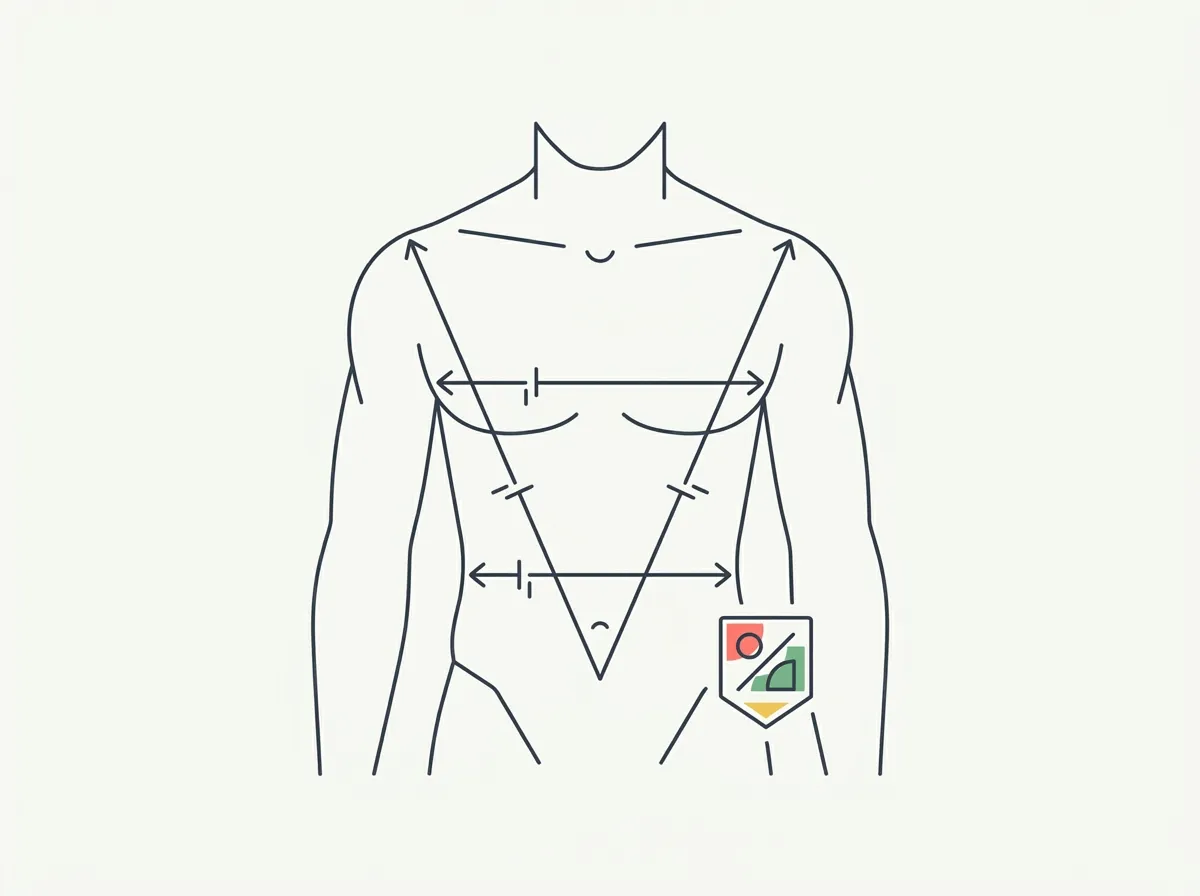
Quick answer: The commonly cited ideal chest-to-waist ratio for men is around 1.33 to 1.4 — chest circumference a third or more larger than your navel waist. Survey averages put the typical American man near 1.0 to 1.1. Measure the chest at the nipple line, the waist at the navel, and divide; the fast lever is waist fat.
You tape your chest at 42 inches and your waist at 34, divide, and get 1.24. Then you search for what's ideal and find 1.618 — the golden ratio — and conclude your torso is a disaster, because 1.24 is nowhere near it.
Except that 1.618 figure isn't for your measurement. It belongs to the shoulder-to-waist ratio, taped higher up at the deltoids, where circumference runs several inches bigger than the chest line. Chest-to-waist is a different measurement with a different ideal, and mixing the two is the most common way people misjudge their own proportions. This page covers the chest version: what's commonly cited as ideal, what chest you need at your waist size, how to measure both ends correctly, and which of the two levers to pull first.
What is the chest-to-waist ratio?
Divide your chest circumference — taped relaxed at the widest point, across the nipple line — by your waist circumference at the navel. A 42-inch chest over a 32-inch waist is a ratio of 1.31: your upper torso is 31 percent bigger around than your waist.
The number captures the taper of the torso itself — the visual slope from ribcage and pecs down to the waistline. It's the measurement behind suit sizing ("drop" is literally chest minus waist), behind the classic proportions systems of the pre-steroid era, and behind a good share of what reads as "fit" in a T-shirt.
Where you start matters for expectations. Putting commonly cited survey averages together — an average chest around 40 to 42 inches, an average navel waist around 40 — the typical American man's ratio lands near 1.0 to 1.05. A cylinder, roughly. Younger and leaner men commonly measure 1.1 to 1.2. The ideals below sit well above both, and the gap is mostly waist.
What is the ideal chest-to-waist ratio?
Commonly cited ideals for men cluster around 1.33 to 1.4 — the chest a third or more larger than the waist. The 1.33 figure comes up repeatedly in old-school proportion writing, and tailoring's "athletic fit" assumes a drop in the same territory. Treat the range as a target zone rather than a law: these are aesthetic conventions, not physiology, and nobody has run a definitive experiment on the perfect torso.
| Ratio | What it reads as |
|---|---|
| ~1.0–1.1 | Little visible taper; roughly the commonly cited population average |
| 1.15–1.25 | Noticeable taper; typical of lean or moderately trained men |
| 1.25–1.33 | Clearly athletic; the T-shirt-filling zone |
| 1.33–1.4 | The commonly cited ideal band; strong V-shape from the front |
| 1.4+ | Rare — demands a big chest and back over a genuinely lean waist |
And to head off the comparison directly: the golden-ratio 1.618 figure belongs to the shoulder tape, not this one. Shoulders taped at the deltoid heads commonly run 4 to 6 inches bigger than the chest line on the same man, so the two ideals describe roughly the same physique — they're just sampled at different heights. A man near 1.35 chest-to-waist is commonly in the neighborhood of 1.5+ shoulder-to-waist.
What chest do you need at your waist size?
Find your navel waist, read across. The targets are just multiplication, which is exactly why the table is useful — it shows what each ideal actually demands of the tape:
| Waist | Chest for 1.33 | Chest for 1.4 |
|---|---|---|
| 28 in | 37.2 in | 39.2 in |
| 30 in | 39.9 in | 42.0 in |
| 32 in | 42.6 in | 44.8 in |
| 34 in | 45.2 in | 47.6 in |
| 36 in | 47.9 in | 50.4 in |
Two things jump out. First, at a 32-inch waist, the 1.33 ideal needs a 42.6-inch chest — barely above the commonly cited male average. The ideal torso is less about a huge chest than a controlled waist. Second, the waist column is brutally efficient: a man with a 44-inch chest hits 1.29 at a 34-inch waist and 1.38 at a 32-inch one. Two inches of waist did what would otherwise take years of pressing.
How do you measure chest and waist correctly?
Sloppy tape work swings this ratio more than a year of training does — a deep breath and a lat spread add an inch or two of chest instantly. The protocol, consistent with our average chest size guide:
- Chest: relaxed, arms at your sides. Tape at the widest point — across the nipple line, under the armpits, around the fullest part of the back. No flexing, no puffed ribcage.
- Keep the tape parallel to the floor. A tape that rides up at the back reads high. Check it in a mirror.
- Waist: at the navel, normal exhale. Not sucked in, not pushed out. Snug tape, no skin denting.
- Same conditions every time. Morning, before food and before training. A pump adds real inches that aren't yours to keep.
- Divide chest by waist and log both numbers, not just the ratio — you need to know which end moved.
Remeasure monthly. Week to week, both tapes carry too much noise from food, water, and tape placement to mean much.
What actually moves the ratio?
Two levers, one on each end of the fraction, on very different clocks.
The numerator — chest and back mass — is the slow lever. The tape around your chest wraps pecs, lats, ribcage, and spinal erectors, so rows, pull-ups, and pressing all feed it. But the rate is humbling: a dedicated beginner commonly adds one to two inches of chest circumference in the first year, and it slows sharply after that. This lever raises your ceiling over years.
The denominator — waist fat — is the fast lever. Male fat storage concentrates at the midsection, so a cut pulls inches almost entirely out of the bottom of the fraction. A modest 12-week cut commonly moves the waist two to four inches — arithmetic no amount of chest training matches on that timeline.
Here's the fast lever in isolation — the same man at two body fat levels. These are standardized, photorealistic AI renders from our body fat visualizer — same build, pose, and lighting, so only body fat changes between images.
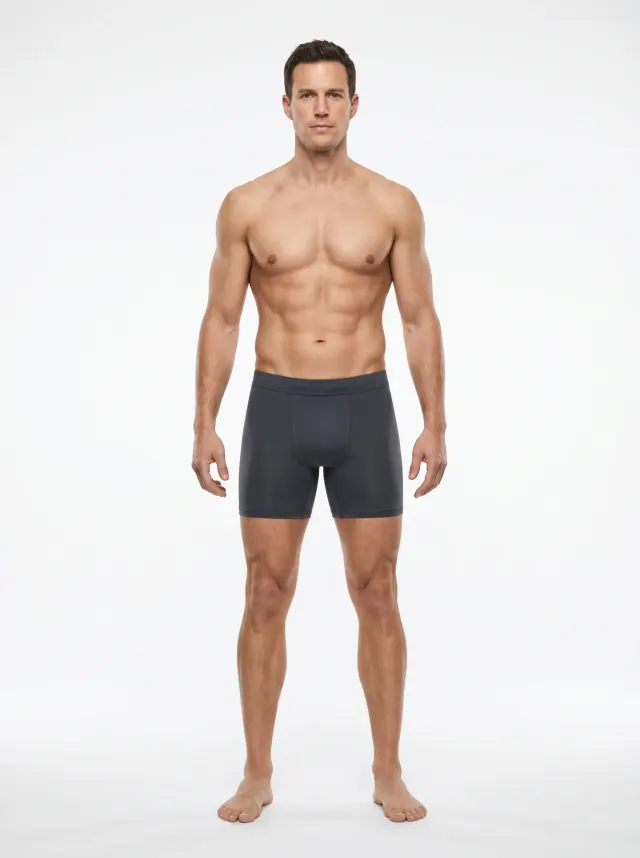
18% body fat — the waist near its natural width, so the chest-to-waist taper the frame is capable of actually shows.
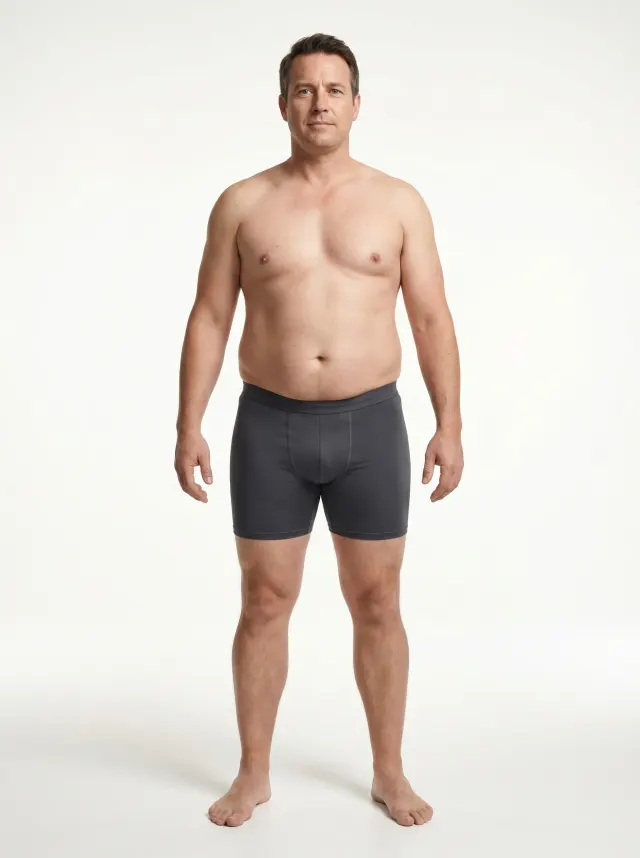
The same frame at 28% — the chest reading is nearly unchanged, but the denominator grew several inches and the taper is mostly gone.
The chest is close to identical in both images. Practically the entire ratio difference lives at the waistline, which is why the standard advice orders the levers: lean out first, then spend years building the top of the fraction.
How does chest-to-waist fit the classic proportions system?
The old-school physique culture that produced the 1.33 figure treated chest-to-waist as one line in a full system — chest, waist, arms, neck, calves, all scaled from wrist or height. Our ideal body measurements guide lays out the whole chart if you want the complete set of targets rather than one ratio.
The reason to track the ratio rather than admire it: it moves slowly, and the tape alone won't show you where the change came from. GainFrame estimates body fat percentage, muscle-group ratings, and a proportions-aware physique score from progress photos, so the waist-shrinking and chest-building halves of the story land in one trend. Estimates from photos rather than clinical measurement, and iOS only — but consistent week to week, which is what a slow-moving ratio needs. For a one-off body fat number today, the free browser estimator runs a single scan a day, no download or signup.
Frequently asked questions
What is a good chest-to-waist ratio for men?
Commonly cited ideals put the chest-to-waist ratio around 1.33 to 1.4 — chest circumference a third or more larger than the navel waist. Most untrained men measure closer to 1.0 to 1.1, because survey averages put the typical chest around 40 to 42 inches over a roughly 40-inch navel waist. Anything past 1.25 with a healthy waist reads as visibly athletic.
Is the chest-to-waist ratio the same as the golden ratio?
No — the 1.618 golden ratio figure belongs to the shoulder-to-waist ratio, taped at the deltoids. The chest tape sits lower, across the nipple line, where circumference runs smaller, so commonly cited chest ideals land around 1.33 to 1.4 instead. Comparing a chest measurement against the shoulder ideal makes almost every physique look worse than it is.
How do you measure your chest-to-waist ratio?
Tape the chest relaxed at the widest point — across the nipple line, under the armpits — arms at your sides, tape parallel to the floor. Tape the waist at the navel on a normal exhale, no sucking in. Divide chest by waist: a 42-inch chest over a 34-inch waist is 1.24. Same conditions every time, morning before food.
Can you improve your chest-to-waist ratio without building muscle?
Yes — waist fat is the faster lever. Body fat concentrates at the male midsection, so a cut narrows the denominator while barely touching the chest reading. Dropping a waist from 36 to 32 inches lifts a 42-inch chest from 1.17 to 1.31 with zero new muscle. Building chest and back mass raises the ceiling, but leaning out reveals the ratio you already have.
What is the average chest-to-waist ratio?
Putting commonly cited survey averages together — a chest around 40 to 42 inches and a navel waist around 40 — the average American man's chest-to-waist ratio lands near 1.0 to 1.05. Younger and leaner men commonly measure 1.1 to 1.2. That gap between average and the 1.33 ideal is mostly waist, which is why fat loss moves this ratio fastest.
Watch the taper develop, not just the tape
GainFrame estimates body fat percentage, muscle ratings, and a physique score from your progress photos — so the waist coming down and the chest filling out show up as one visible trend. Free to start on iOS.
Download GainFrame Free