
Quick answer: A toned stomach is lower body fat plus some core muscle. Crunches build the muscle; only an overall calorie deficit shrinks the layer over it — spot reduction doesn't hold up. Most women see real definition somewhere around 18% body fat, a flatter athletic look in the low 20s. Expect months, and daily appearance swings are normal.
Maybe it was the 30-day crunch challenge. Maybe the 100-a-day ab app, or the plank streak that made it to week six. The core work happened, consistently — and the stomach in the mirror looks the way it did before, which after enough rounds starts to feel personal.
It was never personal, and the effort was never the problem. The advice just aimed at the wrong layer. A toned stomach is a body composition outcome with two ingredients — some core muscle, and a thin enough fat layer to show it — and crunch challenges only touch one of them. This is the same honest math as our toned arms guide, applied to the body part with the most myths attached.
What does a "toned stomach" actually mean?
Strip the marketing and it's two variables. Every stomach has abdominal muscle underneath — yours included, right now, already capable of holding a plank. Over it sits a layer of fat, and the thickness of that layer decides almost everything about what shows through.
"Toned" is the look those two produce at a particular combination: a flat, firm midsection with some visible structure. The muscle half responds to training. The fat half responds to an overall energy deficit, on its own timeline. Any product or workout promising a toned stomach should answer one question — which of the two variables does it move? A surprising amount of the genre moves neither.
Can you crunch your way to a toned stomach?
Here's the kindest place to be direct: no exercise removes the fat on your stomach specifically. Spot reduction — the idea that working a muscle burns the fat covering it — has been tested repeatedly, and the research commonly fails to find it. A thousand crunches strengthen the abs and leave the layer above them untouched.
That's why the challenges kept failing, and it's worth absorbing without self-blame. The work was real; the mechanism it relied on doesn't exist. Crunches still have a role — a slightly thicker abdominal wall shows through sooner and gives the midsection its firmness — but the reveal is the deficit's job, and where your body releases fat first is largely genetic. For many women the midsection is mid-to-late in that sequence, which means patience rather than a harder ab routine.
What body fat percentage does a toned stomach show at?
Using the same reference ranges as our women's body fat chart: a flat, firm stomach commonly lives in the 21–24% fitness range, and visible ab definition commonly arrives somewhere around 16–20%, with roughly 18% the most-cited threshold. Genetics slide these numbers a couple of points either way, because fat distribution decides whether your midsection leans out early or late.
Two useful readings of that. If "toned" to you means flat and firm in a fitted top, the low 20s gets there — a range most women can hold comfortably. If it means visible definition, you're aiming near the top of the athletic range, which takes longer and demands more maintenance. Both are legitimate targets; knowing which one you mean sets the timeline honestly.
What does the difference actually look like?
Here's the range, made visible — the same woman at two body fat levels, as standardized, photorealistic AI renders from our body fat visualizer — same build, pose, and lighting, so only body fat changes between images.

Around 22% body fat — the fitness range, where the flat, toned stomach typically lives. Firm midsection, some structure, curves retained.
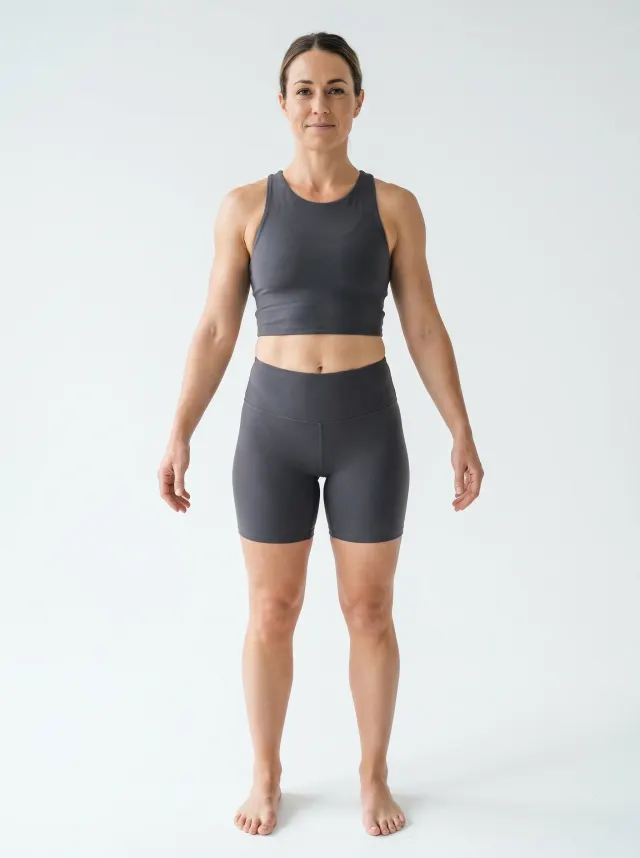
The same frame at 27% — squarely in the healthy average range. The identical core muscle is under there; the layer over it makes the visual difference.
The five-point gap between these images is the honest size of the project. The muscle barely differs between them — the layer does — which is why the playbook below spends more words on the deficit than the crunches.
What is the actual toned-stomach playbook?
Five pieces, none exotic, and the combination is the point.
Run a modest deficit — or recomp. If there's a noticeable layer to lose, a small sustained calorie deficit is the engine; commonly that moves body fat down 0.5–1 percentage point per month. Already near a healthy weight? Eating at maintenance while lifting — classic recomposition, covered in our women's recomp guide — changes the stomach while the scale holds still.
Lift compound movements 2–4 times a week. Squats, hinges, presses, and rows work the core hard as a stabilizer and build the overall muscle that keeps a deficit from just shrinking you. This outproduces an ab-only routine by a wide margin.
Add some direct core work. A couple of sets of planks, cable crunches, or dead bugs a few times a week is plenty — enough to thicken the wall that eventually shows. Nobody accidentally builds a blocky midsection this way; the "bulky waist" fear takes years of heavy, deliberate oblique loading to even approach, per common coaching discussion.
Eat protein. The same 0.7–1 gram per pound of body weight guidance as every other recomp goal — roughly 105–150 grams for a 150-pound woman. It protects muscle in the deficit and keeps you full, which quietly decides whether the deficit survives the month.
Fix the posture, today. An anterior pelvic tilt — hips rotated forward, common in people who sit all day — pushes the lower stomach out regardless of body fat, and standing alignment work commonly changes how a midsection reads within weeks. It's the only item on this list with a fast payoff, so take it.
Why does your stomach look different every day?
Because a stomach's daily appearance mostly reflects what's passing through it. Food volume, sodium, carbohydrate intake, and digestion swing bloat within hours — and for women, menstrual-cycle water retention commonly adds several pounds in the days before a period, much of it midsection-adjacent. Our weight fluctuation guide covers the full mechanics.
The practical rule: a single bad-mirror morning contains zero information about your trend. Tuesday-evening you after a salty dinner and Saturday-morning you are different-looking bodies at identical body fat. Compare like conditions to like conditions across weeks, and let everything else pass without a verdict.
How long does it realistically take?
The math from our abs timeline guide applies directly: distance to your target range, divided by roughly 0.5–1 body fat point per month. A woman at 28% chasing the low-20s flat look is realistically 6–12 months out; chasing visible definition near 18% is longer. The firmer, flatter version commonly shows well before either finish line — posture and early fat loss deliver visible change in the first couple of months.
Slow visual change is exactly the kind the mirror can't judge, and daily bloat noise makes the stomach the worst body part to eyeball. Consistent photos solve it: GainFrame turns weekly check-ins into an estimated body fat trend with aligned before/after comparisons, so a slow midsection change reads as a trend line instead of a daily mood. Estimates from photos rather than clinical scans — but consistent week to week, which is what this particular project needs.
Frequently asked questions
How long does it take to get a toned stomach?
It depends on your starting body fat and how much of the change is fat versus muscle. A sustainable cut commonly moves body fat down 0.5–1 percentage point per month, so a woman at 28% aiming for the low 20s is realistically looking at 6–12 months. A firmer, flatter look often arrives well before full definition does.
Can you tone your stomach without losing weight?
Yes, through recomposition — building core muscle while losing fat at a similar scale weight. If you're already near a healthy weight, progressive lifting with high protein at roughly maintenance calories commonly changes how the stomach looks while the scale barely moves. Posture work adds visible change too, since standing alignment alone alters how the midsection reads.
Do crunches burn belly fat?
No. Crunches build the abdominal muscle underneath, which improves shape and firmness, but spot reduction doesn't hold up in research — working a muscle doesn't burn the fat sitting over it. The layer shrinks only through an overall calorie deficit. Both halves matter: train the core so there's something to see, and lose fat overall so you can see it.
What body fat percentage do women need for a flat stomach?
A flat, firm stomach commonly shows in the 21–24% fitness range for women, and visible ab definition commonly arrives somewhere around 16–20%, with roughly 18% the most-cited point. Genetics shift these numbers a couple of points in either direction, because fat distribution decides whether your midsection leans out early or late in a cut.
Why does my stomach look bigger some days?
Day-to-day stomach appearance swings are normal, especially for women. Food volume, sodium, carbs, and digestion change bloat within hours, and menstrual-cycle water retention commonly adds several pounds in the days before a period. Judge your trend across weeks of consistent-condition photos rather than any single morning — same pose, same light, same time of day.
Watch the layer actually thin
GainFrame estimates body fat percentage from weekly progress photos and lines up before/after comparisons automatically — so a slow stomach change shows as a trend, not a daily guessing game. Free to start on iOS.
Download GainFrame Free