
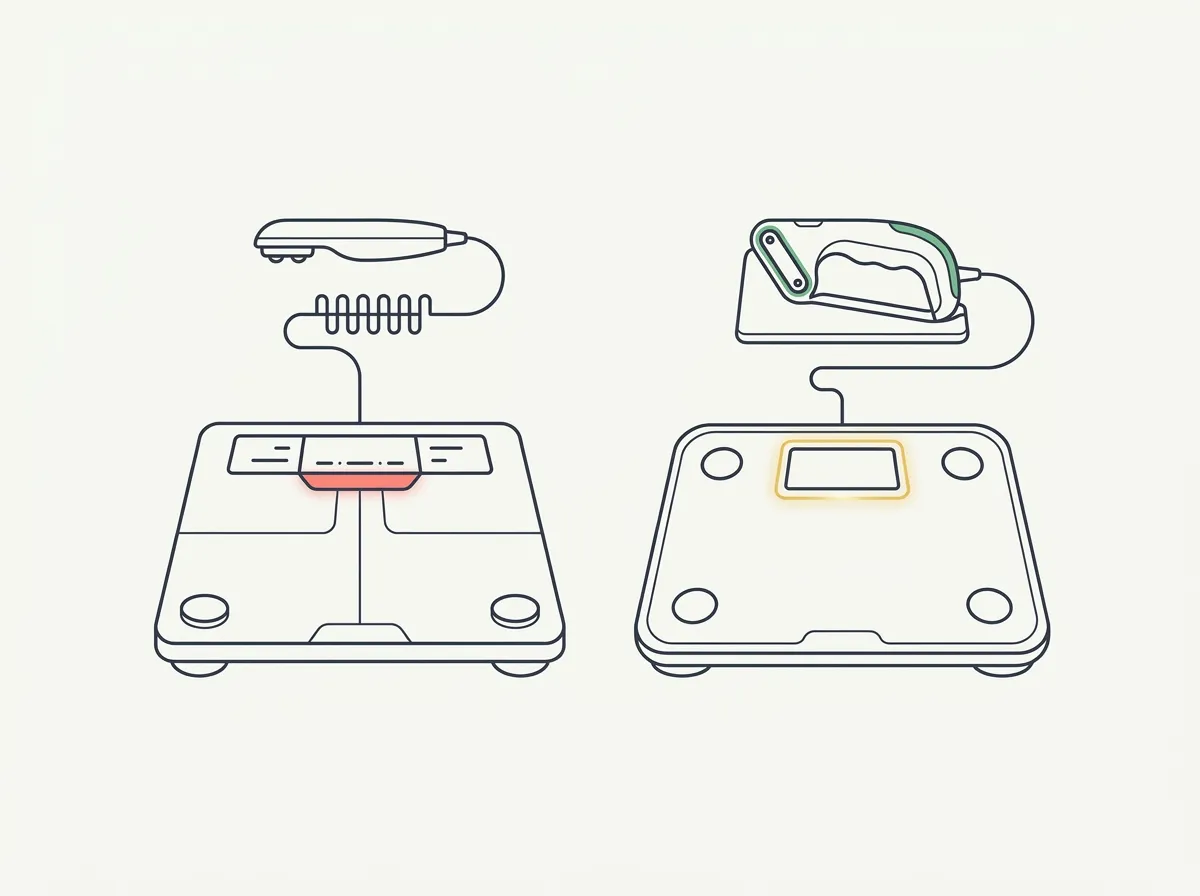
Quick answer: Choose InBody H30 for the shared home-tracking essentials at a lower price. H40 adds body-balance evaluation and leg-muscle information for people who want to review regional patterns. Both are listed in the US store and use hand-and-foot BIA. The extra outputs do not establish greater individual accuracy or directly measure strength.
You are ready to buy a home InBody, then discover that H40 costs $108 more than H30 at the current displayed sale prices. The InBody H30 vs H40 decision comes down to whether its extra outputs are useful enough for your routine.
This comparison uses the manufacturer's US product pages checked October 27, 2026. Both models were listed for purchase, so this is a US buying comparison. We have not performed a hands-on head-to-head accuracy test. European documentation is used only where identified, and regional features and terms should be checked before importing a device.
Which is better for you, InBody H30 or H40?
H30 is the value choice when you want a recurring weight and composition record in the InBody app. It already provides the hand-and-foot measurement format and connected workflow that may be your main reasons for considering this brand.
H40 is the more relevant choice if you specifically want its body-balance evaluation and leg-muscle output. Decide in advance how you would review that information alongside training. A regional label alone should not dictate your next workout.
If neither workflow feels worth the purchase price, our InBody alternatives guide covers other ways to maintain a progress record. Buying a scale is only useful when you will follow the routine it requires.
How do the US H30 and H40 listings compare?
Prices below are the displayed USD prices from InBody USA's H30 listing and H40 listing, checked October 27. Promotions, stock and terms can change.
| Detail | InBody H30 | InBody H40 |
|---|---|---|
| Displayed US sale price | $341.10 | $449.10 |
| Displayed regular price | $379 | $499 |
| Contact system | Eight hand-and-foot electrodes | Eight hand-and-foot electrodes |
| Frequency approach | Triple-frequency BIA | Triple-frequency BIA |
| Connection | Wi-Fi and Bluetooth | Wi-Fi and Bluetooth |
| Core outputs | Weight, body fat, SMM and BMI | Weight, body fat, SMM and BMI |
| Automatic user recognition | Yes | Yes |
| Body-balance evaluation | Not listed as an H30 feature | Listed H40 feature |
| Leg-muscle output | Not listed as an H30 feature | Listed H40 feature |
| US colors shown | Black, white | Green, beige, black |
| US listed product warranty | One year | One year |
InBody Europe's home-model comparison also describes triple-frequency technology for both. The purchase decision here is based on the specific US offers, rather than converting European prices or assuming regional warranties match.
What are H30's main strengths and limitations?
H30 covers the core recurring check-in: step on, use the handle as instructed, then review your own history. Its US listing includes a splash-resistant LCD showing weight, percent body fat, skeletal muscle mass and visceral fat level. Those are useful conveniences when you want a consistent record without adding a separate appointment.
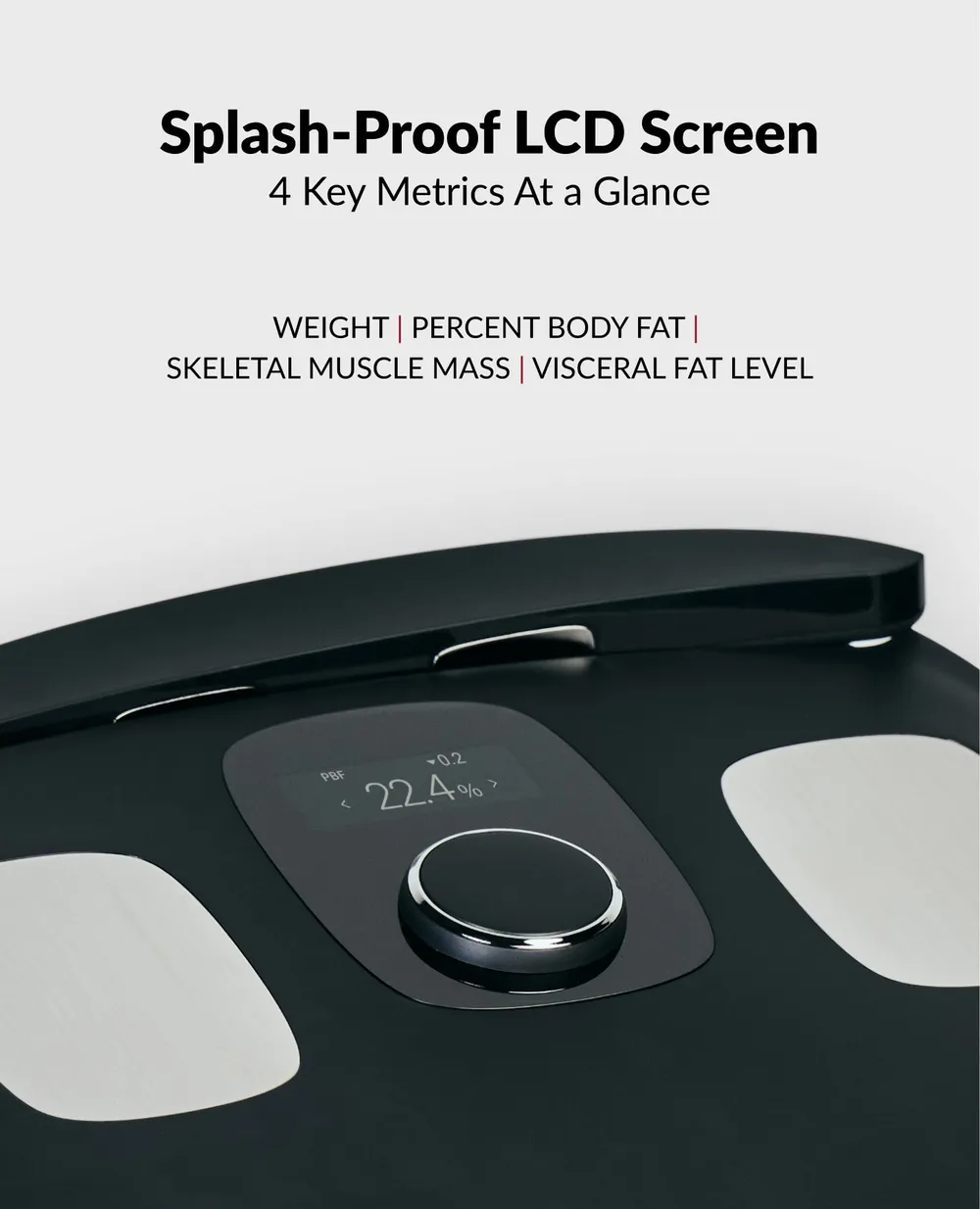
The H30 display and dial in an InBody USA product image. The example illustrates the on-scale view, rather than an accuracy result from our testing.
The limitation is what you can infer from the outputs. A whole-body muscle estimate cannot tell you whether your chest, back or quadriceps have become stronger. And the shared eight-electrode format should not be treated as proof that this home device is interchangeable with whichever professional InBody you used at a gym.
Choose it when your goal is a regular record and the extra H40 fields are unlikely to affect your review. That leaves more budget for other parts of your training rather than a screen you rarely open.
What does H40 add for someone who lifts?
H40's US listing emphasizes body-balance evaluation and lower-body muscle information. These outputs are relevant if you want to inspect regional patterns rather than only a whole-body estimate.
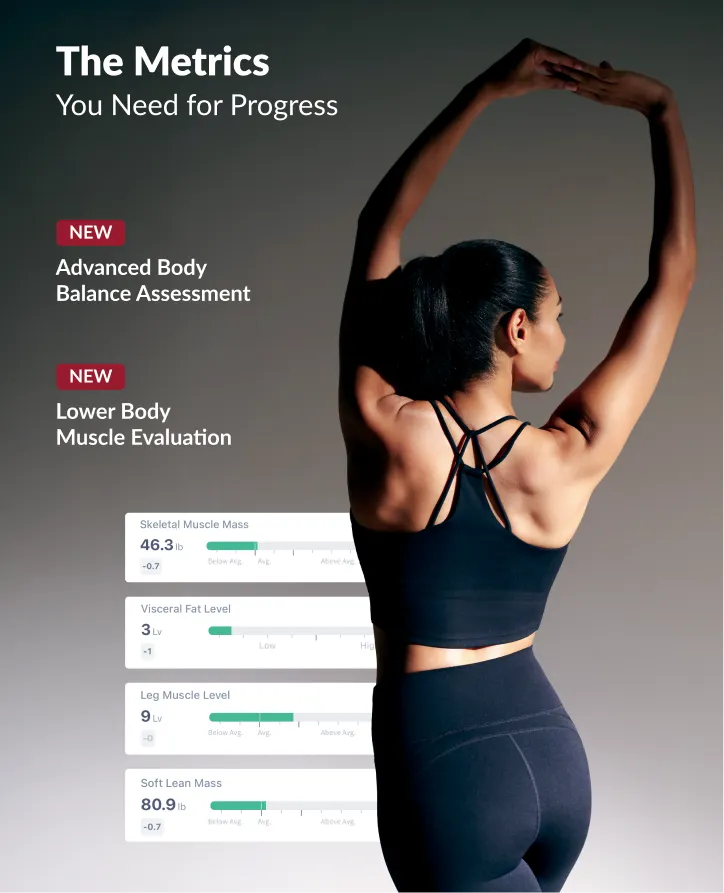
The H40's manufacturer graphic includes a leg-muscle level alongside other metrics. These are sample app outputs, not an assessment of the pictured person by this review. Source: InBody USA.
The practical question is what happens after you see a difference. You might compare it with repeated single-leg exercise performance or review your longer training history. You should also check that the pattern persists under consistent measurement conditions before interpreting a one-off label.
A balance category does not diagnose an injury, establish the cause of pain or measure force production. If what you want is a strength assessment, exercise performance and an appropriate professional assessment answer that question more directly.
Is H40 more accurate than H30?
This comparison does not establish that. Feature count, a higher price and additional regional outputs cannot demonstrate a smaller body-fat error for you. Both products use bioelectrical impedance, and the manufacturer's preparation guidance emphasizes consistent conditions.
InBody makes broader accuracy claims on its product pages. To compare these exact models, we would need model-specific evidence using the same reference method and comparable participants, including individual agreement results. We have not independently validated that comparison here.
Keep one measurement method consistent when reviewing a training phase. If you switch devices, mark the date and establish a new baseline. The smart-scale accuracy guide explains why a different percentage does not by itself prove that the new device is better.
Is the H40 upgrade worth $108 more?
At the checked sale prices, the difference is $108. At the displayed regular prices, it is $120. Those calculations compare hardware only, before taxes or any changes to the offer.
The upgrade makes sense when you can name a recurring use for its additional information. For example, you might already keep regional training notes and want to examine the manufacturer's balance output alongside them. That is a more concrete reason than expecting the premium model to automatically settle every question about muscle gain.
If you only plan to check weight and overall body-fat estimates, H30 covers that use case. If you mainly want photos and a training diary, reconsider whether either scale is the missing part of your system. Our body-composition scale guide compares different price levels and formats.
What should you verify before ordering either model?
Buy the version intended for your region and confirm the seller's current terms. The US and European storefronts display different prices and warranty periods, so a cheaper imported listing is not automatically the same purchase.
- Check the exact model name, regional app support and seller.
- Read the current return and warranty terms.
- Confirm which metrics you want on the scale versus in the app.
- Check any integration field you rely on rather than assuming the whole report exports.
- Read the model's setup, preparation and use restrictions.
- Decide where you will record changes in devices or measurement conditions.
For your first check-ins, follow the manufacturer's routine on a hard, level surface with the intended hand and foot contact. Avoid building a comparison from a relaxed morning reading and a post-workout reading on another day.
How do you keep the scale result connected to visible progress?
Put your longer scale history beside training performance, waist measurements and consistent photographs. Each contributes different context. When they disagree, investigate the record before changing your program to satisfy a single metric.
The free progress-photo comparison tool lets you place two check-ins side by side. It can help you review appearance, but photos cannot validate an InBody result or directly measure muscle mass. Use the muscle-gain progress guide to build a repeatable review.
First, choose the model for the information you will use. Second, set up the same measurement routine each time. Third, evaluate several progress records together before deciding whether your training needs to change.
What else should you know?
What is the main difference between InBody H30 and H40?
H40 adds body-balance evaluation and leg-muscle information to the shared home-tracking workflow. H30 is the lower-cost option for the core weight and composition record. Choose the upgrade when you have a clear use for those extra outputs, and review them alongside performance and other records rather than as standalone training instructions.
Are InBody H30 and H40 available in the United States?
Both models were listed in InBody USA’s own store when checked on October 27, 2026. The displayed sale prices were $341.10 for H30 and $449.10 for H40. Prices and stock can change. Check the current US product page and regional app support before ordering, especially from an overseas seller.
Does H40 measure muscle strength?
Its muscle and balance outputs describe the manufacturer’s body-composition assessment. They do not measure how much force you can produce in a particular movement. Use repeatable exercise performance to evaluate strength, and treat a persistent regional difference as something to investigate in context rather than a complete explanation of your training.
Will H40 give me the same result as a professional InBody?
Do not assume results are interchangeable across models or settings. This comparison has not independently established agreement between H40 and a professional device for an individual. Keep the model and testing conditions in your records, and mark a new baseline when changing systems instead of merging the results without context.
Which model is better if I only want to track weight and body fat?
H30 is the more economical choice between these two when those are your main requirements. Before buying, compare whether the InBody app and handle-based routine justify the price over simpler options. Whichever device you choose, use consistent conditions and keep other progress records so a single estimate does not dominate your decisions.
Keep your progress in one photo history
GainFrame is our iPhone app for progress photos and estimated body-composition trends. Free download with limited check-ins. Optional Pro subscription; current price and limits are shown in the app. Photo estimates cannot verify a scan or diagnose a health condition.
Get GainFrame for iPhone